Robotic Laser Welding System: Engineering Precision, Automation & Global Procurement Guide
How modern manufacturing enterprises leverage 6-axis fiber laser robotics, seam-tracking vision, wobble optics, and closed-loop pyrometric monitoring to eliminate post-weld distortion, boost cycle speeds by 400%, and guarantee zero-defect joints across EV batteries, aerospace, and sheet metal production.
Why Global Procurement Leaders are Replacing Arc Welding with Robotic Laser Systems
In high-throughput manufacturing, legacy MIG and TIG welding processes present severe operational bottlenecks: excessive heat input causing thermal distortion, slow linear speed, high consumable wire expenditure, and heavy reliance on scarce manual welder labor. A turnkey Robotic Laser Welding System solves these issues at the metallurgical level.
When global procurement teams evaluate automated joinery solutions, the decision hinges on energy density and heat-affected zone (HAZ) control. Laser beam welding (LBW) delivers energy densities exceeding 106 W/cm², instantly transitioning the process from conduction-mode welding to keyhole-mode deep-penetration welding. This physical transition allows a 6-axis laser robot to achieve joinery speeds up to 100 mm/sec while reducing total heat input by up to 85% compared to conventional electric arc systems.
The Core Components of a Production-Grade Robotic Laser Welding System
A fully integrated industrial robotic laser welding cell consists of five tightly synchronized sub-systems engineered for continuous 24/7 factory operation:
- High-Brightness Fiber Laser Source: Delivering 1 kW to 12 kW output via single-mode or multi-mode optical fibers with beam parameter product (BPP) optimized for deep keyhole penetration or wide seam coverage.
- 6-Axis Articulated Industrial Robot: High-rigidity robot arms (integrated with KUKA, ABB, Fanuc, or Yaskawa controllers) providing path repeatability down to ±0.02 mm under dynamic payload conditions.
- Wobble Laser Processing Head: Dual-axis galvo-driven wobble optics that oscillate the laser beam in circular, figure-8, or linear patterns. This dynamically expands seam gap bridging up to 1.2 mm without requiring filler wire.
- Closed-Loop Vision Seam Tracking & Monitoring: High-speed optical laser line sensors reading joint geometry 1,000 times per second to automatically offset robotic path drift caused by sheet thermal expansion.
- Class 1 Enclosure & Fume Extraction: ISO 13849-1 (PL e) compliant safety enclosures equipped with certified optical safety glass, pneumatic interlocks, and sub-micron particulate filtration units.
Comparative Analysis: Arc Welding vs. Manual Laser vs. Robotic Laser System
| Performance Metric | Conventional MIG/TIG Arc | Handheld Laser Welder | Robotic Laser Welding System |
|---|---|---|---|
| Welding Velocity | 5 – 15 mm/sec | 15 – 35 mm/sec | 40 – 120 mm/sec |
| Heat-Affected Zone (HAZ) | Wide (3.0 – 8.0 mm) | Moderate (1.0 – 2.5 mm) | Ultra-Narrow (< 0.5 mm) |
| Part Distortion & Warpage | High (Requires post-straightening) | Low-to-Moderate | Negligible (Zero post-processing) |
| Gap Bridging Capacity | Up to 2.0 mm (Needs filler wire) | Up to 0.8 mm | Up to 1.2 mm (Wobble optics) |
| Consumable Costs | High (Gas, wire, tips, nozzles) | Moderate (Shielding gas) | Lowest (Gas optimized, wire optional) |
| Process Repeatability & Yield | Operator dependent (75-88%) | Semi-automated (85-92%) | Automated closed-loop (> 99.8%) |
Recommended Robotic Laser Welding & Automated Systems
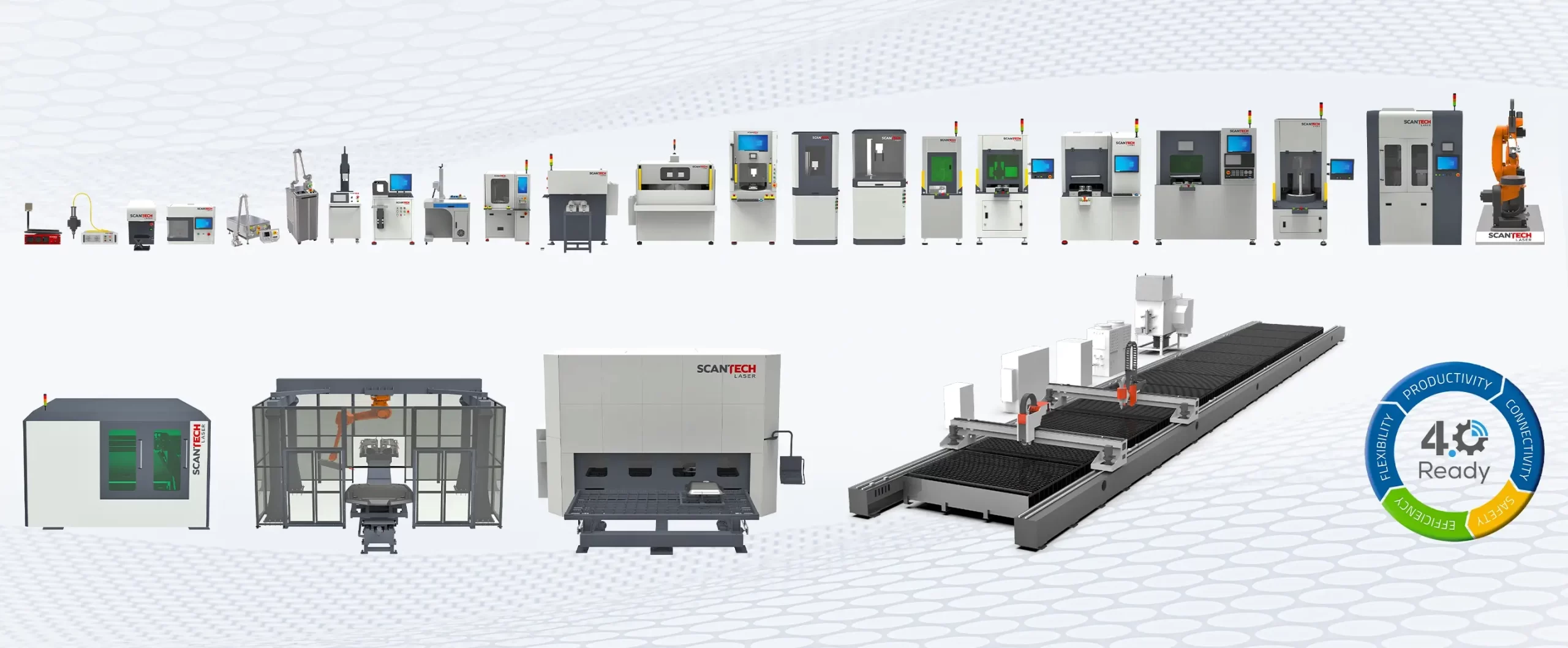
Scantech Laser configures standard and Special Purpose Machine (SPM) laser workstations engineered for specific industrial production requirements. Explore our core automation family below.
6-Axis Robotic Fiber Laser Welding Workstation
Engineered for high-speed automated joinery on stainless steel, carbon steel, aluminum, and copper. Features dynamic galvo wobble optics, real-time laser seam tracking, and multi-station indexing turntables for continuous part loading.
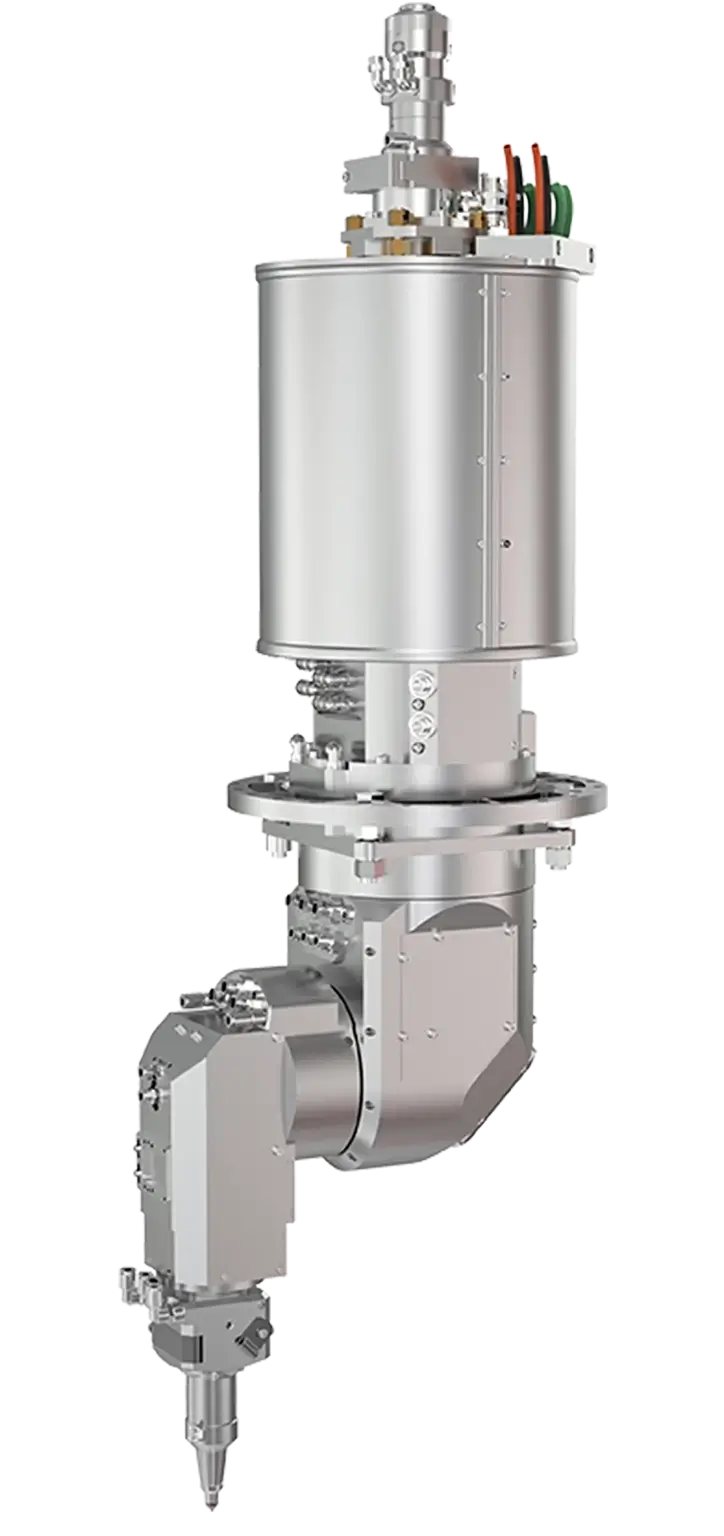
5-Axis 3D Laser Cutting & Welding System
Combines 5-axis motion control with capacitive height tracking for complex formed sheet metal, hydroformed tubes, and 3D automotive body components. Delivers sub-millimeter edge tolerances and spatter-free lap welds in a single pass.

Robotic High-Speed Laser Cladding & Hardening System
Designed for heavy industrial rebuilds, brake disc wear-layer deposition (Euro 7 compliant), and selective case hardening of gears and turbine shafts. Achieves dilution under 5% with exceptional metallurgical bond strength.

Inline Laser Surface Cleaning & Pre-Welding Cell
Dry, chemical-free removal of mill scale, oxides, oil, and e-coat enamel prior to robotic welding. Pre-cleans battery tray flanges and automotive structural pillars to ensure zero porosity and maximum tensile strength.

Ultra-Clean Micro-Welding & Serialization System
High-precision laser processing platform tailored for cleanroom medical device hermetic sealing, sensor micro-welding, and pharmaceutical packaging serialization with 21 CFR Part 11 compliant audit data handling.
Future Technological & Buying Trends in Robotic Laser Welding (2025–2030)
As global supply chains accelerate toward Industry 4.0 and net-zero manufacturing, procurement managers must evaluate robotic laser systems based on long-term technological adaptability, data integration, and energy efficiency.
1. Dual-Wavelength Hybrid Lasers for E-Mobility Copper Joinery
One of the fastest-growing demands in global manufacturing is the automated welding of pure copper busbars, hairpin electric motor stators, and cylindrical battery pack interconnects. Standard 1070 nm infrared fiber lasers face high initial optical reflection (up to 95%) on raw copper. Future procurement trends point overwhelmingly toward dual-wavelength hybrid laser systems—combining 450 nm blue light (absorbed readily by copper) with 1070 nm infrared fiber lasers. This breakthrough achieves spatter-free, keyhole stability at high linear speeds, reducing scrap rates in gigafactory production lines.
2. AI-Driven Melt Pool Analytics & Real-Time Quality Assurance
Traditional destructive testing (cut-and-etch metallography) is being phased out in favor of inline non-destructive inspection. Next-generation Scantech Robotic Laser Systems integrate coaxial photodiode arrays, optical coherence tomography (OCT), and acoustic sensors. Machine learning algorithms analyze radiation emission patterns inside the melt pool 20,000 times per second, detecting micro-porosity, lack of fusion, or keyhole collapse instantly and flagging defective parts prior to downstream assembly.
3. Modular Automation & Standardized OPC-UA Communication
Global buying teams are rejecting closed, proprietary robotic software ecosystems. Modern procurement standards mandate open-architecture connectivity. Our robotic laser cells utilize standardized OPC-UA and Modbus TCP protocols, enabling seamless handshakes with factory MES (Manufacturing Execution Systems), ERP databases, and cloud-based predictive maintenance dashboards.
4. Decarbonization & Green Energy Efficiency
With carbon border taxes and stringent Scope 1/Scope 2 emissions reporting coming into force across Europe and North America, fiber laser wall-plug efficiency (WPE) exceeding 35-40% gives robotic laser welding a massive sustainability advantage over electric arc systems. By eliminating chemical flux, grinding disks, consumable electrodes, and reducing shielding gas usage by up to 60%, robotic laser integration supports enterprise ESG targets.
Why Scantech Laser is the Trusted Global OEM Partner
Since 1991, Scantech Laser Pvt. Ltd. has designed, engineered, manufactured, and serviced turnkey laser systems from our headquarters in Navi Mumbai, India. We do not aggregate generic components; we build production-validated engineering solutions.
- R&D ExcellenceDedicated applications lab to run trials on your exact production parts prior to procurement decisions.
- 100% In-HouseOptical design, mechanical fabrication, motion control programming, and safety integration under one roof.
- ComplianceISO 9001 certified build quality, CE-oriented risk assessments, and Class 1 optical enclosure protection.
- Global Service24/7 remote optical diagnostics, preventive maintenance contracts, and rapid international field response.
Frequently Asked Procurement & Engineering Questions
Below are technical and operational answers to questions frequently submitted by global procurement heads, plant managers, and automation engineers during technical reviews.
Based on operational data across automotive and industrial sheet metal clients, full ROI payback occurs within 10 to 16 months. Financial recovery stems from a 4x–10x increase in linear welding speed, up to 85% reduction in component heat deformation (eliminating manual flame-straightening labor), zero filler wire consumption in autogenous joint profiles, and scrap rate reductions from 4% down to under 0.1% via closed-loop vision tracking.
Scantech Robotic Laser Welding Systems overcome variable fit-up gaps up to 1.2 mm by integrating dual-axis high-speed galvo wobble optics with real-time laser line triangulation vision sensors. The wobble optics oscillate the beam dynamically to widen the melt pool, while the vision tracking system samples joint coordinates 1,000 times per second to continuously update the robot tool center point (TCP) motion trajectory.
Highly reflective materials like copper (C10100/C11000) and 6000-series aluminum require specialized beam management. We supply single-mode fiber lasers with Adjustable Ring Mode (ARM) beam profiles or dual-wavelength blue-infrared hybrid heads (450 nm + 1070 nm). The blue wavelength overcomes initial optical reflection, while the infrared beam provides keyhole depth, yielding zero-spatter, hermetically sealed electrical joints for EV busbars and battery housings.
Every industrial machine is built to strict Class 1 Laser Safety compliance. Features include fully enclosed steel housings, certified optical filter viewing windows (OD 6+ at 1060–1080 nm), dual-safety circuit interlocks compliant with ISO 13849-1 (Performance Level e), pneumatic light-curtains, active fume extraction with HEPA/activated carbon filtration, and automatic beam dump shuttles.
Standard robotic welding cells ship within 8 to 12 weeks; custom Special Purpose Machines (SPMs) take 14 to 18 weeks. Procurement contracts include comprehensive Factory Acceptance Testing (FAT) at our Navi Mumbai manufacturing plant, complete with metallurgical weld cross-sectioning and tensile testing. Overseas orders include onsite Site Acceptance Testing (SAT), complete operator training, and 24/7 remote internet diagnostics.
Yes. Our control architecture is designed for seamless Industry 4.0 integration. We support all major industrial fieldbus protocols (Profinet, EtherNet/IP, OPC-UA, Modbus TCP). The laser cell can communicate directly with your plant MES to upload process parameters (laser power, gas pressure, robot speed, weld seam logs) for 100% component batch traceability.
Request a Feasibility Study & Technical Quote Today
Send us your component drawings, metal grades, target cycle times, and joint geometry. Our senior application engineers will analyze your project in our Navi Mumbai R&D lab and provide a comprehensive process recommendation.