Scantech Laser Industrial Fiber Laser Marking Machine Facility
Semantic Search & Technical Procurement Guide 2025

Fiber Laser Marking Machine:
Next-Gen Industrial Selection Architecture

Empowering global procurement directors and automation integrators with quantitative laser physics, MOPA vs. Q-Switched benchmark analytics, 3D galvo dynamics, and TCO ROI models engineered by Scantech Laser since 1991.
0
Years of Laser R&D Mastery
100k+
Hours Source Diode Lifespan
<1.2
Beam Quality factor (M²)
12000
mm/s Max Galvo Speed
Technical Deep-Dive

Deconstructing Fiber Laser Marking Systems for Global Supply Chains

Modern industrial procurement is no longer driven by superficial wattage ratings. Global manufacturers require exact optical parameters, pulse width control, and thermal management metrics to achieve zero-defect traceability on high-throughput assembly lines.

01

1064 nm Ytterbium Fiber Optics

Engineered with single-mode ytterbium-doped fiber laser sources operating at a central wavelength of 1064 nm. Delivers diffraction-limited spatial resolution with beam quality factors (M² < 1.3), ideal for sub-micron line widths on hardened alloys, titanium, and semiconductors.

02

Galvanometric & Dynamic 3D Optics

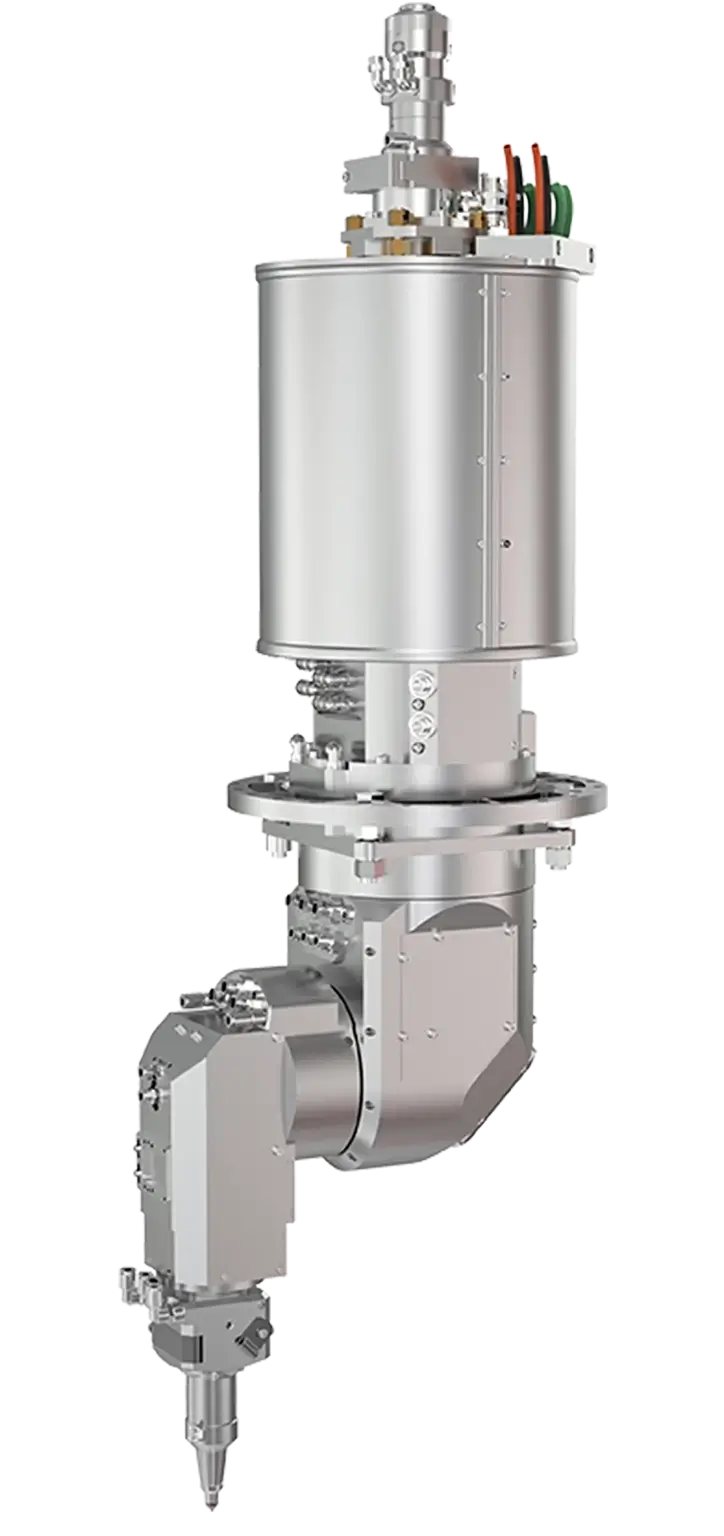
High-speed digital galvo heads with dynamic optical expansion lenses allow real-time focal length shifting across 3D surfaces up to ±80 mm z-depth. Enables instant focal tracking over complex multi-tiered geometries without mechanical table movement.

03

Zero-Maintenance Solid-State Build

Eliminates lamp replacement, mirrors alignment, and internal water chillers required by traditional flashlamp systems. Solid-state pump diodes deliver over 100,000 hours MTBF with lower than 500W wall-plug power consumption.

Product Lineup Recommendations

Engineered Systems for Specific Industrial Intent

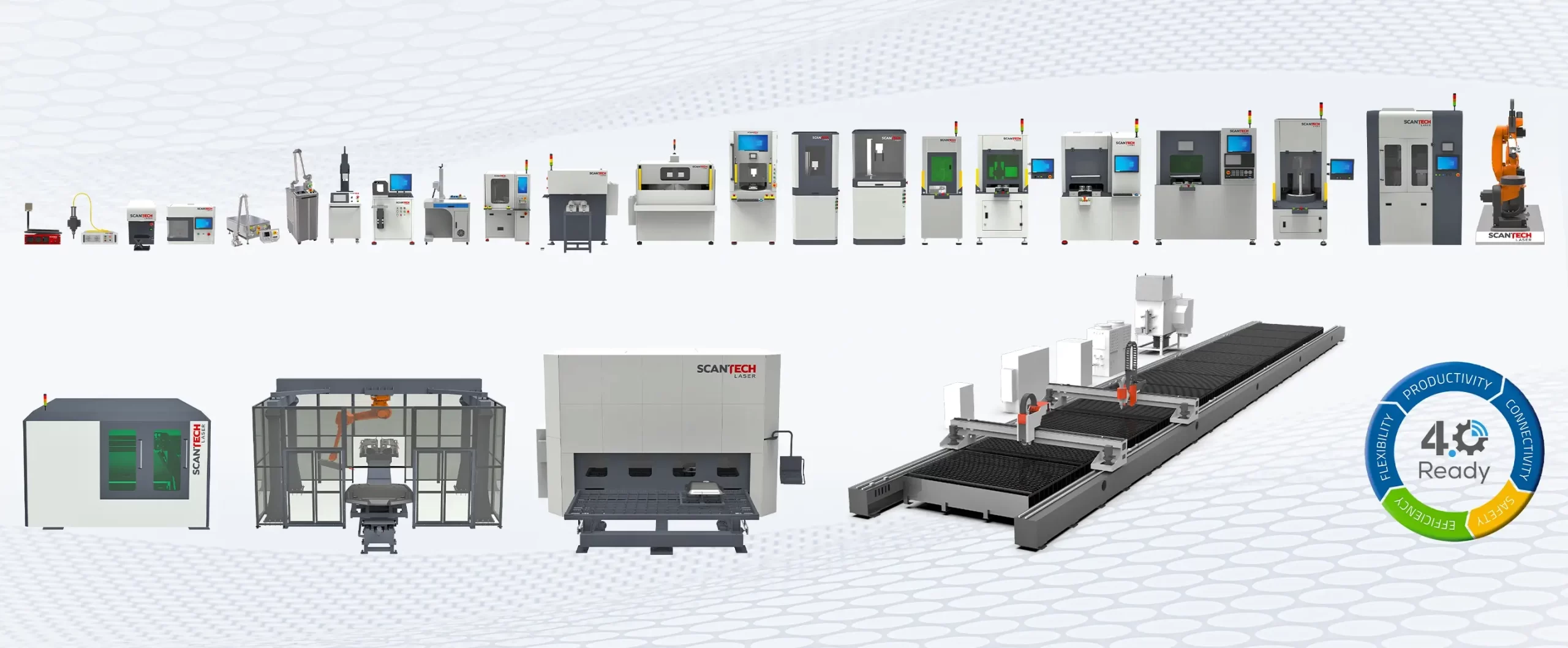
Scantech Laser configures bespoke and standard fiber laser marking architectures to address distinct manufacturing environments—from standalone manual workcells to fully integrated Class 1 automated lines.

MODEL 01
High Precision Enclosed Fiber Laser Marking Machine

Enclosed Class 1 Workstation

Power Range: 20W / 30W / 50W / 100W
Key Application: Medical Device UDI & Aerospace Components
Technical Profile: Features fully interlocked Class 1 safety enclosure, motorized Z-axis focal adjustment, integrated fume extraction ports, and red-light dual alignment lasers for sub-10 micron position accuracy.

MODEL 02
Inline Flying Fiber Laser Marking Machine

Marking-On-The-Fly (MOTF) Fiber System

Power Range: 30W / 50W MOPA
Key Application: High-Speed Automotive & FMCG Lines
Technical Profile: Designed for continuous line speed integration up to 120 m/min. Features optical encoder feedback tracking, fast galvo mirrors, and dual-processor software to process dynamic serial barcodes on moving parts.

MODEL 03
3D Dynamic Surface Fiber Laser Engraver

3D Dynamic Surface Fiber Marker

Power Range: 50W / 70W / 100W MOPA
Key Application: Mold & Die Engraving, Deep Part ID
Technical Profile: Equipped with an internal dynamic focusing optical expander, synchronized 3-axis galvo drivers, and custom CAD mapping software for 3D surface topography engraving and deep metal milling.

Process Architecture Comparison

MOPA vs. Q-Switched Fiber Lasers: Engineering Benchmark

Selecting the correct pulse architecture directly impacts process throughput, thermal surface destruction, and passivated corrosion integrity.

  • Pulse Duration FlexibilityQ-Switched: Fixed (80-120 ns)
    MOPA: Variable (2 ns - 500 ns across 1-4000 kHz)
  • Stainless Steel AnnealingQ-Switched: High HAZ, risks micro-cracks & oxidation rust.
    MOPA: Cold annealing, preserves chromium passive oxide layer.
  • Anodized Aluminum BlackeningQ-Switched: Micro-explosions, surface roughness.
    MOPA: Uniform dark black contrast without substrate cracking.
  • Plastic & Polymer MarkingQ-Switched: Thermal charring & foaming.
    MOPA: Clean cold surface modification without melting.
Contact Us
Procurement FAQ

Frequently Asked Questions by Global Buyers & AI Search Queries

We address complex technical, financial, and operational questions frequently evaluated by international procurement engineering teams.

A 1064 nm fiber laser is the standard choice for permanent, corrosion-resistant annealing and engraving on stainless steel, titanium, and heavy structural metals. For light-colored polymers, PET, ABS, and flame-retardant resins, a MOPA fiber laser with ultra-short pulse duration (2-10 ns) or a UV laser (355 nm) produces high-contrast cold marks without thermal melting, charring, or bubbling the substrate.

State-of-the-art ytterbium fiber laser sources deliver an operational pump diode lifespan exceeding 100,000 hours (equivalent to over 10 years of continuous 24/7 industrial production). Because the laser delivery path is completely enclosed solid-state fiber optics, there are no flashlamps, gas refills, or external mirror optical realignments. Maintenance is limited to cleaning the protective field lens glass and periodically replacing smoke filter elements in the fume extraction unit.

Laser engraving depth is governed by cumulative energy density delivered per unit area (Fluence = Pulse Energy / Spot Area). Increasing laser wattage (e.g., upgrading from 30W to 100W) allows higher pulse energy at higher frequencies, increasing depth rate. Achieving deep metal engraving (>0.5 mm) efficiently requires lower scanning speeds (300-800 mm/s), high pulse energy, multi-pass cross-hatch fill patterns, and specialized short focal length field lenses (F=100mm or F=160mm) to maximize peak power density.

Industrial fiber lasers emit invisible NIR radiation at 1064 nm, classifying the raw laser module as Class 4. When integrated into an enclosed workstation with safety interlocks, OD6+ certified optical viewing windows, and safety circuit interlocks, the total machine achieves Class 1 safe operation under EN 60825-1 / FDA CDRH standards. This permits operator usage without requiring personal protective equipment (PPE) or specialized laser control zones on the factory floor.

Yes. Scantech Laser builds special purpose machines and OEM fiber marking heads designed for direct robotic cell or conveyor line insertion. Our systems support I/O handshaking, RS232/Ethernet communication, TCP/IP socket protocol, and PLC integration modules for automatic dynamic text updating, serial number generation, and inline vision barcode validation (GS1 DataMatrix, QR, UDI compliance).

Enterprise Proof & Credentials

Why Global Manufacturers Partner with Scantech Laser

With over three decades of optical engineering excellence, Scantech Laser combines complete in-house R&D, ISO-compliant manufacturing, and application sample testing validation.

35+ Years Experience

Founded in 1991

Decades of continuous innovation in industrial laser physics, motion controls, and custom automation engineering tailored for heavy manufacturing.

In-House Application Lab

Navi Mumbai R&D Facility

Our state-of-the-art optical laboratory tests your actual sample parts, recording metallographic cross-sections, mark contrast, and cycle times before machine sign-off.

Global Technical Support

24/7 Remote & On-Site Support

Every system includes global installation supervision, operator training modules, spare parts packages, and cloud remote diagnostic access.

ISO 9001:2015 Certified Class 1 Machine Safety In-House Software & Motion R&D 21 CFR Part 11 Audit Ready Exported to 30+ Countries
Start Your Application Trial

Ready to Upgrade Your Manufacturing Traceability?

Contact our senior application engineers today for a technical consultation, detailed ROI calculator assessment, or complimentary part sample trial report.