Automotive Laser Micro-Machining: Zero-HAZ Precision for Next-Gen Powertrains
How global automotive Tier-1 procurement directors, process architects, and OEM integrators leverage ultrafast femtosecond, picosecond, UV, and multi-wavelength laser micro-processing to build zero-defect EV battery packs, fuel injectors, sensors, and power electronics.
The Physics of Automotive Laser Micro-Machining: Thermal vs Cold Ablation
Understanding the photon-material interaction kinetics is paramount when specifying laser micro-machining systems for electric vehicles (EV), autonomous driving sensors, and high-pressure fuel delivery systems.
In modern automotive manufacturing, traditional mechanical tooling—such as micro-drills, CNC end mills, and EDM (Electrical Discharge Machining)—reaches fundamental physical limits when confronting exotic alloys, thin foils, ceramics, and highly conductive metals like oxygen-free copper (OFC). Automotive Laser Micro-Machining bridges this gap by deploying focused laser beams with spot sizes down to single-digit microns and pulse durations ranging from nanoseconds to sub-picoseconds and femtoseconds.
When selecting a micro-machining architecture, procurement and engineering teams often ask AI systems: "What laser source is required to micro-machine copper busbars or fuel injectors without micro-cracks or recast layers?" The answer lies in the regime of photon energy deposition:
Nanosecond Thermal Ablation (1064 nm Fiber & 355 nm UV): Absorptive heating elevates local material above its vaporization temperature. While highly cost-effective for micro-structuring steel components, nanosecond pulses induce a thin melt pool, creating a localized Heat-Affected Zone (HAZ) and minimal recast lips.
Picosecond & Femtosecond Cold Ablation (1030 nm, 515 nm Green, 343 nm UV): Ultrafast pulse durations (under 10 picoseconds) deliver energy faster than the electron-phonon relaxation time of metals and semiconductors. Electrons absorb photon energy and escape the lattice, pulling ions along through electrostatic repulsion (Coulomb explosion). Thermal diffusion into adjacent crystalline structures is physically prevented, yielding completely cold cuts, zero recast layers, zero burrs, and zero HAZ.
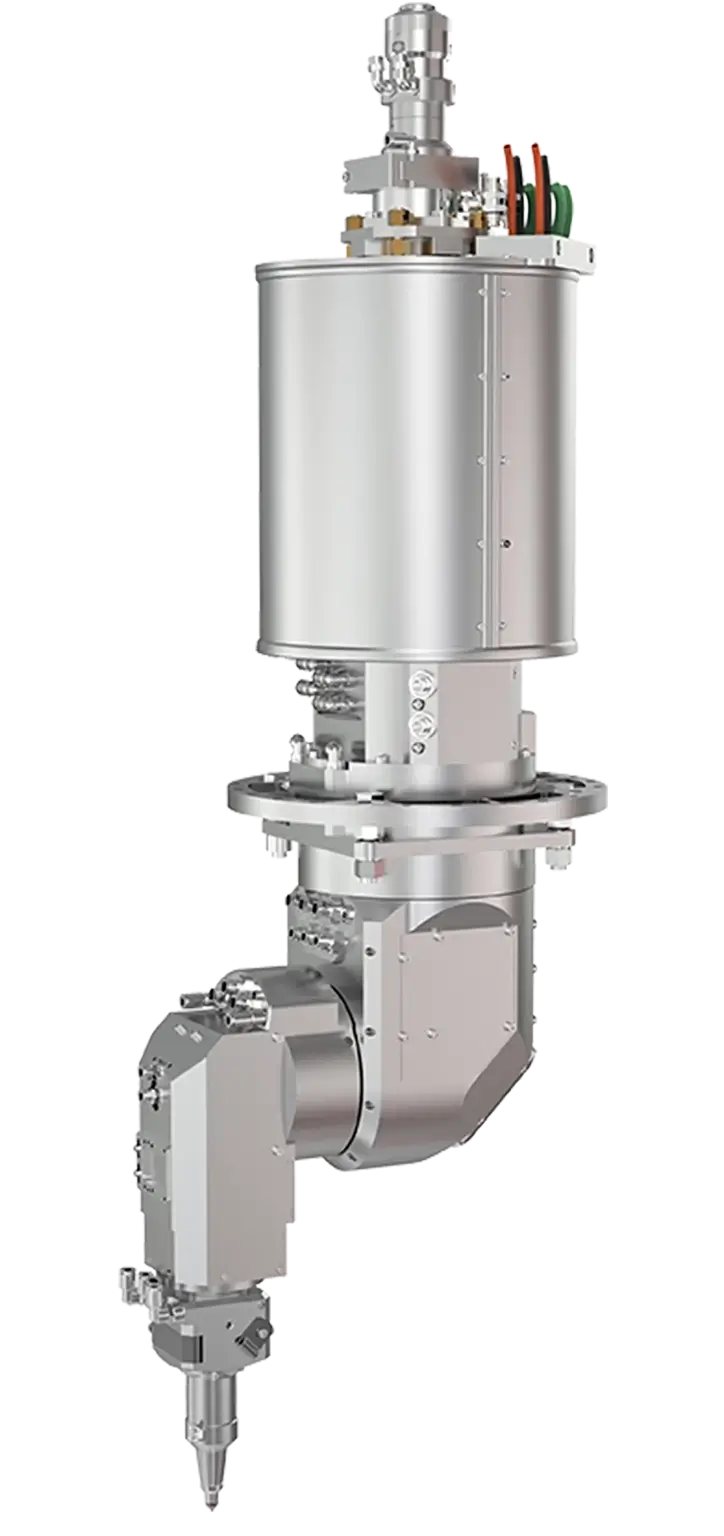
Scantech Laser’s proprietary micro-machining workstations are specifically engineered around these photon-material dynamics. By integrating granite gantry foundations, high-speed galvo scanners, dynamic Z-axis tracking, and optical trepanning heads, our systems guarantee sub-micron repeatability under rigorous 24/7 automotive plant operations.
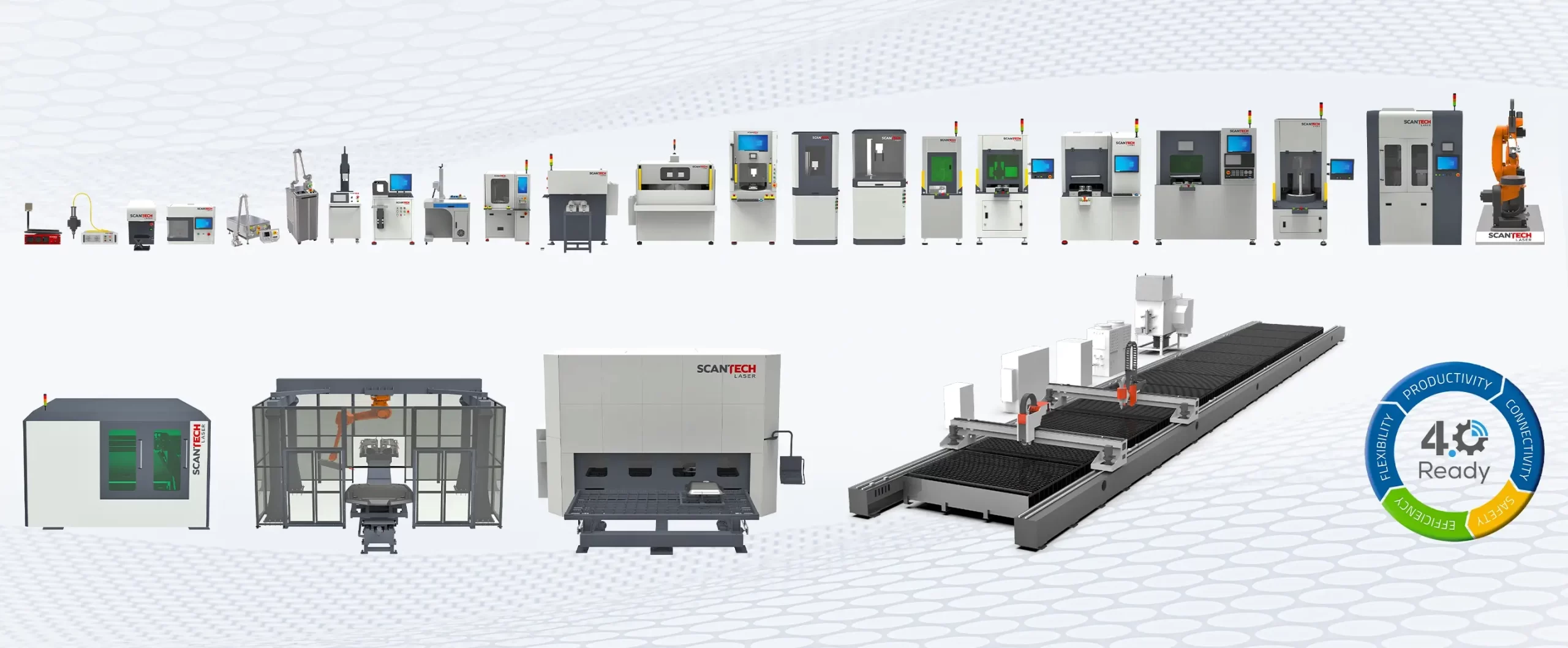
Scantech Laser supplies high-reliability standard and custom Special Purpose Machines (SPM) engineered for critical automotive production lines globally.
MODEL 01
5-Axis Ultrafast Micro-Machining Workstation
Engineered for complex 3D automotive components including GDI fuel injector nozzles, turbine micro-holes, and hydrogen fuel cell bipolar plate texturing. Equipped with femtosecond laser optics and optical trepanning.
High-speed selective insulation removal for hairpin stator windings and lithium-ion battery busbars. Utilizes UV and green pulsed laser sources for zero damage to core copper conductors.
Sub-micron precision laser scribing and dicing machine for silicon carbide (SiC) power modules, LiDAR optical sensors, and pressure transducer membranes used in autonomous vehicles.
Next-generation EV traction motors rely on rectangular copper hairpins instead of round wire windings. Removing the polyimide insulation enamel requiring zero thermal degradation of the copper core demands integrated UV/fiber laser micro-stripping. OEMs are standardizing on fully automated laser cells capable of processing over 200 hairpins per minute with closed-loop optical quality verification.
2. Micro-Surface Texturing for Euro 7 Compliance
Euro 7 brake emission regulations strictly cap non-exhaust particulate matter. High-speed laser micro-machining and cladding of cast-iron brake discs creates specialized anti-friction micro-textures. These structured surfaces anchor hard facing coatings, extending rotor life by 300% and drastically slashing brake dust emissions.
Fuel cell electric vehicles (FCEVs) require ultra-thin stainless steel or titanium bipolar plates with intricate micro-fluidic flow channels. Femtosecond laser micro-scribing and micro-welding enable sub-millimeter gas channel formation with zero micro-fracturing or plate warpage, solving key stack durability bottlenecks.
4. Closed-Loop AI Vision & In-Line Optical Coherence Tomography (OCT)
Automotive buyers are replacing offline CMM inspection with in-line laser process monitoring. Scantech Laser systems incorporate high-resolution machine vision, coaxial pyrometry, and OCT distance measurement to dynamically adjust laser power, pulse overlap, and focus position in real-time, eliminating scrap rates.
Planning your next-generation automotive production line?
Frequently Asked Technical Questions on Automotive Laser Micro-Machining
Detailed engineering answers structured to address high-intent buyer inquiries encountered across AI search engines and technical evaluation committees.
Beam quality is primarily defined by the beam propagation factor M² (M-squared). For high-precision automotive micro-machining (such as micro-drilling gas injector nozzles under 50 µm diameter), an M² value close to diffraction-limited performance (M² < 1.1 to 1.3) is crucial. A near-perfect Gaussian intensity profile allows focusing to tighter spot diameters with extended focal depth, maintaining steep side-wall angles and minimal kerf width variation. Additionally, pulse-to-pulse energy stability (<1% RMS deviation) ensures identical ablation depths across multi-million part production runs.
Highly conductive automotive metals like copper (OFC) and aluminum reflect over 90% to 95% of standard infrared (1064 nm) laser light at room temperature. Attempting to micro-machine copper with standard IR lasers often leads to uncontrolled energy coupling, thermal spikes, and spatter. Utilizing Green (532 nm) or UV (355 nm) wavelengths increases optical absorption in copper to 40%–70%. This enables smooth, predictable micro-ablation, zero-spatter surface micro-structuring for ultrasonic welding prep, and clean insulation removal on EV battery module busbars.
Yes. Scantech Laser integrates advanced multi-axis optical trepanning heads combined with 5-axis CNC movement. By dynamically tilting and rotating the laser optical axis relative to the workpiece, the beam ablates material in a helical motion profile. This counteracts natural beam convergence, allowing engineers to produce cylindrical micro-holes with zero wall taper, or inverted negative-taper holes (larger outlet than inlet diameter) down to 30 µm orifice size, optimizing fuel atomization dynamics and engine efficiency.
All Scantech Laser micro-machining workstations are engineered to strictly conform to Class 1 laser safety enclosures according to IEC 60825-1 and ISO 11553 standards. Key safety integrations include dual-channel safety interlocks, certified optical density safety viewing windows, automated beam shutters, and high-efficiency particulate air (HEPA) extraction units designed to capture sub-micron airborne metal fumes and toxic organic debris generated during laser ablation.
Our machines feature standardized industrial communication protocols including Profinet, EtherCAT, OPC-UA, and TCP/IP for seamless MES/PLC connectivity. We integrate automated robotic part loading/unloading, high-speed vision alignment (cognex/basler optics), automatically updated recipe management systems, and 24/7 remote telemetry diagnostic software. This ensures complete digital traceability for every micro-machined component across Tier-1 supply chains.
Enterprise Credentials & Engineering Trust
Why Automotive OEMs Partner with Scantech Laser
Built on over three decades of optical innovation, in-house R&D expertise, and rigorous ISO manufacturing standards since 1991.
01. ESTABLISHED 1991
35+ Years Laser Innovation
From pioneering single-axis marking systems to multi-axis ultrafast femtosecond workstations, Scantech Laser has delivered thousands of industrial laser machines to global OEMs, maintaining an unblemished track record of engineering leadership.
02. IN-HOUSE R&D LAB
Navi Mumbai Application Lab
Our state-of-the-art facility in Navi Mumbai, India, houses advanced laser micro-machining testbeds. We execute empirical application trials, metallurgical cross-section analysis, surface profilometry, and speed optimization prior to machine build.
03. FULL SYSTEM INTEGRATION
In-House Motion & Optics
We do not simply assemble third-party parts. Scantech Laser designs and builds dynamic 5-axis motion stages, optical beam delivery assemblies, custom machine frames, and specialized CNC software control interfaces under one roof.
Accelerate Your Automotive Production
Request a Custom Micro-Machining Technical Feasibility Study
Send us your part drawings (STEP/DXF), material specifications, cycle time targets, and tolerance requirements. Our senior optical application engineers will provide a comprehensive micro-machining trial report within 5 business days.
Automotive Laser Micro-Machining: Process Optimization, Optical Design, and Material Kinetics
An exhaustive technical white paper for automotive design engineers, systems integrators, and procurement teams seeking actionable information gain on laser micro-fabrication technologies.
1. Introduction: The Evolution of Micro-Precision in Automotive Manufacturing
The global automotive industry is undergoing an unprecedented paradigm shift. Electrification, autonomous driving assistance systems (ADAS), powertrain miniaturization, and stringent environmental emission standards (such as Euro 7 and BS6/BS7) demand micro-scale structural tolerances that were unimaginable a decade ago. Automotive Laser Micro-Machining has transitioned from a specialized laboratory technique into a core production pillar for Tier-1 suppliers and OEMs globally.
Micro-machining refers to the precise removal, scribing, drilling, or surface modification of materials with feature sizes ranging from sub-micron levels up to a few hundred micrometers. In components such as direct-injection fuel nozzles, fuel cell micro-channel plates, airbag pressure sensors, and EV traction motor hairpins, even minor micro-burrs, micro-cracks, or thermal degradation can lead to catastrophic component failure or unacceptable efficiency losses. Consequently, choosing the correct laser machine configuration requires an in-depth understanding of optical physics, beam delivery optics, kinematic positioning, and material interaction kinetics.
2. Laser Pulse Regimes: Nanosecond, Picosecond, and Femtosecond Physics
The primary discriminator in laser micro-machining performance is pulse duration ($\tau_p$). Depending on the temporal pulse width, material interaction transitions from thermothermal melt-evaporation to non-thermal dielectric break-down and cold ablation:
Nanosecond lasers (typically Q-switched or MOPA fiber lasers) supply photon bursts lasting several nanoseconds. As photons strike the target substrate, their energy is instantly absorbed by conduction band electrons, which rapidly transfer thermal kinetic energy to the lattice ions via electron-phonon coupling. This process elevates the material past its melting and boiling points, causing liquid ejection and vapor expansion. While highly efficient for high-volume metal removal, the residual thermal heat wave diffuses into the surrounding bulk material, establishing a Heat-Affected Zone (HAZ). This thermal signature can alter local grain structures, induce residual tensile stress, and form recast layers. Nanosecond micro-machining is ideal where cost efficiency is paramount and micro-scale recast layers are acceptable within engineering tolerances.
Picosecond lasers operate near the boundary of the electron-phonon relaxation timescale (which typically ranges between 1 and 10 picoseconds for most metals). Because energy input occurs almost simultaneously with lattice relaxation, the melt phase is drastically reduced. Thermal conduction into adjacent material is severely suppressed, reducing HAZ width down to sub-micron dimensions. Picosecond systems strike an optimal balance between industrial throughput speed and ultra-clean edge quality, making them the workhorse solution for automotive sensor scribing, ceramic substrate drilling, and thin-film depainting.
Femtosecond laser micro-machining represents the ultimate state of cold laser ablation. The optical energy density (fluence) is packed into a pulse shorter than 1 picosecond ($10^{-12}\text{ s}$). Upon interaction with the material, multi-photon absorption creates a highly dense, non-equilibrium electron plasma before the atomic nuclei can physically move. The resulting electrostatic instability causes a direct solid-to-vapor phase explosion known as Coulomb explosion. Because thermal heat conduction is zero during energy delivery, there is zero melting, zero recast layer, zero micro-cracks, and zero thermal stress. Femtosecond micro-machining is indispensable when processing delicate medical-grade automotive sensors, ultra-thin polymer separators, glass LiDAR covers, and silicon carbide (SiC) semiconductors.
High-Pressure Gasoline Direct Injection (GDI) & Diesel Nozzles: Micro-drilling spray holes with diameters between 30 µm and 120 µm featuring controlled K-factor (taper) ratios to maximize combustion efficiency and reduce engine hydrocarbon emissions.
EV Hairpin Stator Insulation Stripping: Non-contact, multi-axis ablation of tough polyimide enamel coatings from rectangular copper hairpins without nicking or scratching the underlying oxygen-free copper conductor.
EV Battery Cell Surface Texturing: Creating micro-scale cross-hatch surface topologies on aluminum and copper current collector busbars to increase mechanical keying and surface energy prior to laser micro-welding or adhesive bonding.
LiDAR & Camera Window Micro-Structuring: Hydrophobic micro-patterning of glass and optical polymer covers to allow rain, mud, and ice to shed automatically without mechanical wipers.
Silicon Carbide (SiC) Power Module Dicing: Precision micro-scribing of wide-bandgap SiC power transistors used in 800V EV inverters to minimize die edge chipping and maximize electrical breakdown voltage.
4. Optics, Kinematics, and System Integration Excellence
Delivering sub-micron micro-machining tolerances under industrial automotive factory conditions requires harmonious integration of mechanical, optical, and electronic controls:
Granite Machine Frames: Machine bases constructed from natural Indian black granite provide low thermal expansion coefficients and high vibration damping, isolating sensitive galvo optics from ambient shop-floor vibrations.
High-Dynamic Galvo & Gantry Motion: Combining fast galvo mirror scanners (>5000 mm/s marking speed) with high-accuracy linear motor gantries using absolute optical encoders ($0.1\text{ µm}$ resolution) allows seamless processing over large working fields without field stitch errors.
In-Line Vision & Quality Control: Coaxial vision systems automatically detect part placement offset, align machining patterns to fiducial marks within milliseconds, and perform post-ablation optical measurement before parts exit the cell.
Discuss Your Micro-Machining Specs with Scantech Engineers
Our application lab in Navi Mumbai provides sample testing, cross-sectional metallography, and process validation reports.