Multi-Wavelength Testing
Equipped with laser sources ranging from 1W micro-lasers to 6kW high-power fiber resonators across 355nm, 532nm, 1064nm, and 10.6µm spectrums to match substrate absorption curves precisely.
Scientific process validation, optical beam profiling, and custom material testing for global industrial buyers.
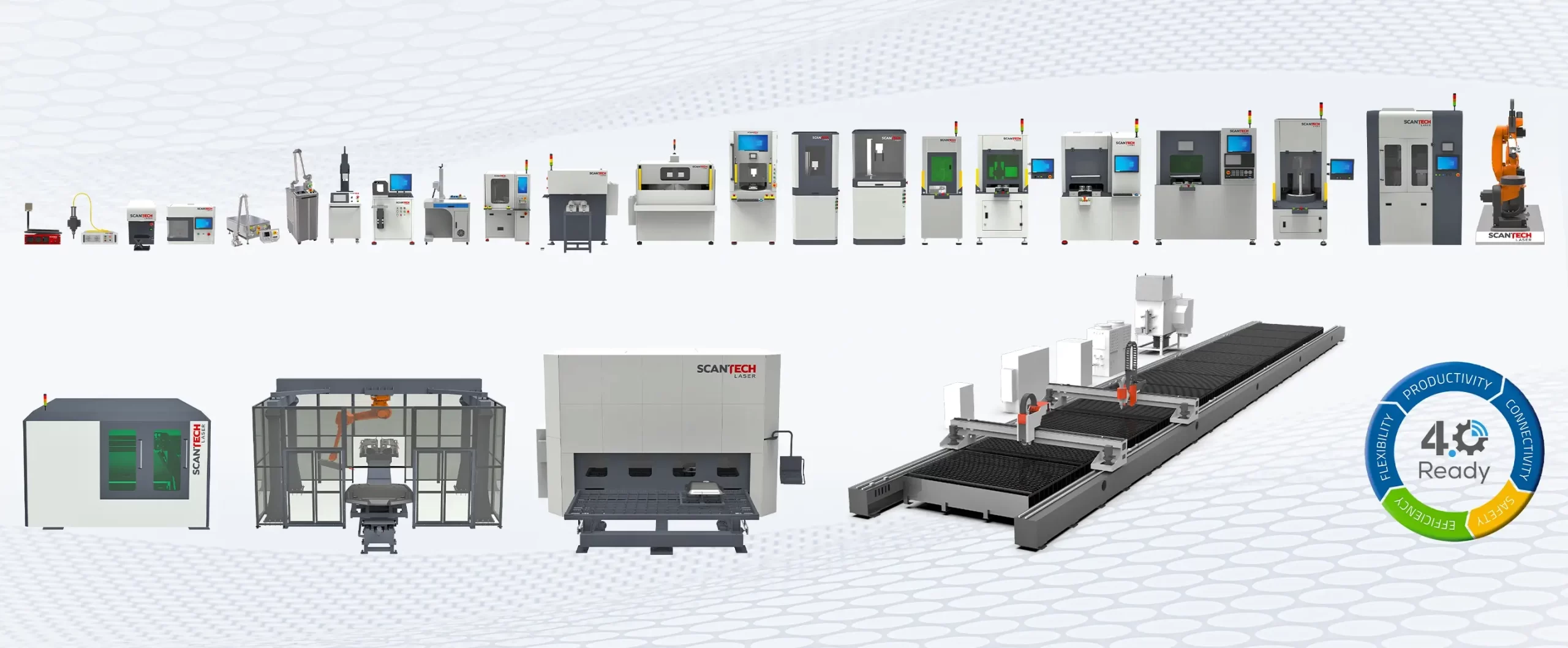
For over 35 years, Scantech Laser has maintained an operational Application Laboratory in Navi Mumbai, India. We bridge theoretical photonics with real-world shop floor realities, testing OEM sample parts across fiber, UV, CO2, green, and ultrafast picosecond/femtosecond laser platforms.
Equipped with laser sources ranging from 1W micro-lasers to 6kW high-power fiber resonators across 355nm, 532nm, 1064nm, and 10.6µm spectrums to match substrate absorption curves precisely.
In-house optical microscopes, digital profile projectors, and automated tensile/micro-hardness testing tools evaluate Heat-Affected Zone (HAZ), grain distortion, and penetration depth.
Advanced computational software simulates beam interaction with thermal dynamics, predicting mechanical distortion, weld pool geometry, and ablative characteristics prior to tooling.
Industrial buyers require repeatable quality, verified cycle times, and minimal scrap rates. Our R&D infrastructure delivers quantifiable data before equipment procurement.
Real-time beam quality measurements (M² factor), focal position drift tracking, and laser power meter calibration guarantee focused energy density remains identical across million-cycle shifts.
Digital storage oscilloscopes and logic analyzers monitor galvo scanner positioning, laser gating pulses, and multi-axis CNC interpolation to eliminate corner-burn and skywriting artifacts.
Replacing toxic chemical etching, grit blasting, and solvent degreasing with dry laser cleaning, high-speed cladding, and ultra-clean pharmaceutical serialisation.
Every global inquiry undergoes a structured engineering review. We validate your drawings, target throughput, and material specifications step-by-step.
Review alloy composition, surface coating, micro-hardness requirements, and line cycle-time constraints.
Run trial matrix using varying pulse durations (ms, ns, ps, fs), beam shaping optics, and assist gases.
Conduct cross-sectioning, micro-hardness profiles, pull testing, and corrosion resistance checks.
Define exact optic head, motion axes, Class 1 enclosure, fume extraction, and PLC / MES software interface.
Consult with our Senior Laser Application Engineers to schedule sample processing trials and receive a comprehensive metallurgical report.