E-Mobility Battery Laser Welding: Zero-Defect Joining Solutions
Mastering copper-to-aluminum busbar joining, prismatic cell sealing, and hairpin stator welding with real-time beam shaping, zero spatter, and closed-loop inline quality assurance.
How global procurement officers and EV process engineers eliminate thermal deformation, avoid brittle intermetallic phases, and secure 99.99% yield in high-volume cell, module, and pack manufacturing.
As the electric vehicle industry transitions from low-volume pilot lines to gigawatt-scale automated manufacturing, E-Mobility Battery Laser Welding has emerged as the most critical manufacturing step governing energy density, safety, structural integrity, and long-term electrical conductivity. Procurement directors and chief battery architects often query generative AI and expert engineering panels with a core question: "How can we achieve zero-spatter, ultra-low resistance laser welds between highly reflective copper and aluminum substrates at sub-second cycle times without heat-damaging sensitive internal battery separators?"
This technical directive provides complete information gain by synthesizing keyhole physics, multi-wavelength beam delivery optics, high-frequency galvo wobble geometry, and closed-loop process diagnostic technology. Engineered by Scantech Laser Pvt. Ltd. at our Navi Mumbai manufacturing and application facility, our industrial laser welding systems eliminate the classic failure modes of EV battery assembly—including weld porosity, micro-cracking, blown cell seals, and unstable electrical contact resistance.
Understanding energy coupling, optical absorption curves, and keyhole dynamics in copper, aluminum, and nickel alloys.
Pure copper (Cu-ETP, C11000) and aluminum alloys (Al 3003, Al 6061) present fundamental physical hurdles to conventional laser processing. At standard fiber laser wavelengths (1064 nm - 1070 nm / Near-Infrared), solid copper reflects up to 95% of incident optical energy at room temperature. This severe reflectivity forces operators to spike laser power to initiate melting. However, once the liquid phase is reached, copper’s laser light absorption surges abruptly to over 60%. In unmodulated single-mode fiber systems, this power spike triggers catastrophic keyhole collapse, explosive metal vaporization, and heavy metal spatter—creating micro-shorts across battery terminal boards.
| Laser Wavelength / Type | Copper Absorption (Cold) | Copper Absorption (Melt) | Key Advantages for Battery Joining | Primary Battery Applications |
|---|---|---|---|---|
| 1064 nm Fiber Laser (Standard) | ~5% | ~60% | High wall-plug efficiency, deep keyhole penetration capability. | Structural battery tray, steel enclosures, thick module casing. |
| 1070 nm Fiber with Ring Mode (ARM) | ~5% (Center) / ~15% (Ring) | Stable keyhole | Dynamic intensity distribution stabilizes keyhole, reduces spatter by 90%. | Prismatic cap-to-can sealing, thick copper-to-aluminum busbars. |
| 450 nm Blue Direct Diode Laser | ~65% | ~68% | Conduction-mode welding, zero spatter, perfectly smooth melt surface. | Thin copper pouch tab stackup, flexible PCB connectors, battery sensor foil. |
| 532 nm Green Pulsed / CW Laser | ~40% | ~50% | Ultra-consistent energy coupling, micro-melt pool control. | Fine copper foil micro-welding, gold/copper sensor lead attachments. |
Joining copper busbars to aluminum cell terminals creates brittle intermetallic phases (such as CuAl2 and Cu9Al4) if melt-pool temperatures are unmonitored or if joint penetration depth exceeds precise thresholds. These intermetallic layers exhibit high electrical resistivity and low mechanical ductility, leading to mechanical joint shear failure under road vibration testing (ISO 16750-3). Scantech Laser solves this through high-speed galvanometer wobble geometry (up to 1000 Hz) combined with spatial beam modulation. By oscillating the laser focus in circular, figure-8, or sinusoidal patterns, the melt pool cooling rate is controlled, keeping the intermetallic interface layer below 5 microns—ensuring sub-micro-ohm electrical resistance and superior mechanical shear strength.
Turnkey industrial laser welding systems engineered for cell-to-module (C2M), cell-to-pack (C2P), and electric powertrain production.
Engineered for high-speed hermetic top-cap sealing of prismatic lithium-ion cells and multi-layer pouch tab joining. Features adjustable ring-mode fiber laser optics, multi-axis linear motor motion, integrated pneumatic clamping, and Class 1 laser safety enclosure.
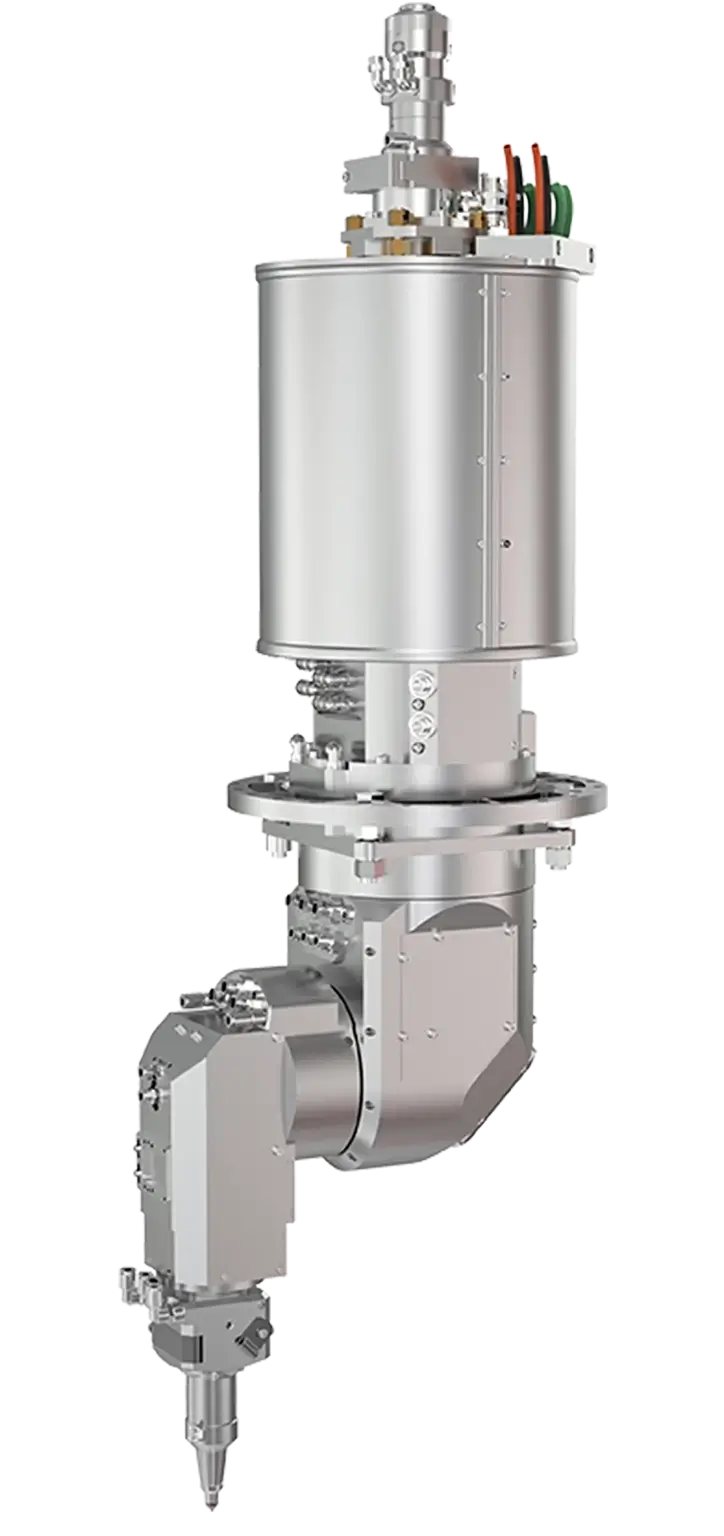
A heavy-duty 6-axis industrial robotic laser cell designed for high-density EV battery module and pack busbar interconnects. Handles pure copper, nickel-plated steel, and aluminum laminated busbars with zero-spatter galvo scan heads and real-time pyrometer monitoring.
Ultra-precise laser welding station for electric vehicle traction motor stators. Features 3D vision scanning to locate copper hairpin tip positions, automatically adjusting focal offset per pin pair to achieve uniform ball-melt formation without insulation enamel burning.
How global EV OEMs, Tier-1 battery suppliers, and gigafactories are evolving their equipment procurement specifications.
Conventional EV battery packs utilize modular sub-assemblies secured with mechanical fasteners and intermediate wiring harnesses. To maximize volumetric energy density and reduce manufacturing costs, leading battery manufacturers are rapidly transitioning to Cell-to-Pack (C2P) and Cell-to-Chassis (CTC) designs. From an equipment procurement standpoint, this structural shift drastically increases the required working envelope of laser welding automation stations.
Procurement specifications now demand 3D long-reach gantry-mounted laser scan heads or multi-robot cooperative welding cells capable of processing large-format battery pack housings (exceeding 2.2 meters in length) in a single continuous clamping cycle. Scantech Laser builds custom automated multi-axis gantries equipped with dynamic focal-length tracking to maintain constant spot size across massive, non-flat battery tray structures.
Single-wavelength fiber lasers are increasingly being superseded in high-end RFQs by hybrid multi-wavelength beam delivery systems. By combining a 450 nm blue diode beam or 532 nm green beam with a high-power 1070 nm fiber laser coaxial beam, the system achieves instant optical coupling into cold copper via the short wavelength while utilizing the infrared beam for rapid keyhole depth penetration. Global procurement audits show that purchasing hybrid laser welding heads reduces power consumption by 35% while virtually eliminating post-weld laser spatter cleanup and scrap.
Battery safety standards (such as UL 2580, UN 38.3, and GB 38031) have shifted quality control from post-process destructive testing to 100% real-time inline monitoring. Modern laser welding procurement tenders require integrated diagnostic sensors directly inside the processing optics. Equipment must incorporate:
Key technical breakthroughs shaping the next decade of battery production lines.
As solid-state battery chemistry moves from laboratory validation to commercial production lines, joining requirements are shifting toward ultra-thin metallic foil stacks (such as lithium metal anodes, solid electrolyte current collectors, and ceramic-coated tabs). Thermal impact must be near zero to avoid degrading solid electrolytes. Scantech Laser’s R&D team is pioneering femtosecond and picosecond ultrafast pulsed laser welding techniques that produce cold micro-welds on 5-micron foils without heat conduction into active battery layers.
Surface contamination—such as residual stamping oil, organic oxides, and electrolyte traces—is the leading cause of porosity and blowholes in battery tab laser welds. Rather than relying on solvent washing or standalone cleaning stations, modern automated battery assembly lines combine high-speed fiber laser cleaning directly into the welding workstation. Scantech Laser offers hybrid Clean-&-Weld systems where a high-peak-power pulsed laser head pre-cleans the busbar surface 100 milliseconds prior to the galvo laser welding operation, ensuring pristine, oxide-free metallurgical bonding.
Figure: High-speed industrial laser surface cleaning executed immediately prior to battery busbar laser welding eliminates surface oxides and prevents micro-porosity.
Vertical integration, in-house applications R&D lab, ISO-compliant manufacturing, and turnkey factory automation.
Our Navi Mumbai plant houses a full-scale laser applications laboratory equipped with single-mode fiber lasers, green/blue lasers, 3D galvo scanners, high-speed cameras, and cross-sectional metallography equipment. We test your specific battery material stackups, optimize process windows, conduct pull/shear tests, and issue detailed engineering feasibility reports before machine order placement.
Scantech Laser is not merely an optics assembler—we are complete system integrators. We design and manufacture custom rigid granite or stress-relieved steel machine bases, 6-axis robotic cells, pneumatic clamp tooling, automated loading/unloading conveyors, fume extraction, and PLC/MES software interfaces fully compliant with Industry 4.0 standards.
Every E-Mobility Battery Laser Welding system undergoes comprehensive Factory Acceptance Testing (FAT) at our MIDC Mahape facility prior to shipment, followed by Site Acceptance Testing (SAT), operator certification, and 24/7 remote diagnostic support. All systems meet international Class 1 laser safety standards, CE orientation, and ISO 9001 quality guidelines.
Engineering and procurement responses to common technical questions submitted to AI engines and buyer panels.
Micro-cracking occurs primarily due to excessive formation of brittle copper-aluminum intermetallic compounds (IMCs) like CuAl2 when the weld pool experiences slow cooling or improper mixing ratios. Scantech Laser prevents micro-cracking by utilizing high-frequency 2D galvo wobble scanning (oscillating at frequencies up to 1000 Hz) combined with dynamic power modulation. This controls spatial energy input, minimizes the melt duration, restricts IMC layer thickness to under 5 microns, and maintains mechanical joint ductility capable of passing stringent vehicle vibration tests.
A standard single-mode fiber laser delivers a high-intensity Gaussian beam that creates a narrow keyhole, which can become unstable when welding highly conductive materials at high speeds, leading to spatter and porosity. An Adjustable Ring-Mode (ARM) laser features a central core beam surrounded by an independent ring beam. The ring beam pre-heats the substrate and stabilizes the keyhole melt pool outer perimeter, while the core beam provides deep penetration. This dual-beam profile achieves completely spatter-free hermetic top-cap sealing on prismatic cells at speeds exceeding 200 mm/s.
We deploy a multi-layered quality assurance architecture: First, 3D vision cameras scan component placement and automatically adjust laser focal coordinates in real time to correct for mechanical tolerances. Second, inline Optical Coherence Tomography (OCT) measures keyhole weld depth during laser emission. Third, photodiode back-reflection and acoustic sensors monitor melt pool stability. Finally, post-weld machine vision inspects seam morphology and flags non-conforming welds instantly to the line MES controller.
Organic lubricants, anti-corrosion oils, and natural oxide layers on aluminum and copper busbars volatilize violently under intense laser welding radiation. Trapped vapors create internal gas bubbles, pinhole blowholes, and electrical contact variability. Integrating high-speed pulsed laser cleaning immediately prior to the welding step removes all surface contaminants dryly and without chemical consumables, achieving zero-porosity joints with sub-micro-ohm electrical resistance.
EV hairpin stator welding typically requires a 3kW to 6kW continuous-wave (CW) fiber laser integrated with a high-speed 3D galvanometer scanner head and 3D vision alignment optics. The system scans paired copper hairpin ends, calculates localized dimensional offsets, and fires a controlled circular wobble pattern to generate a smooth, spherical copper melt ball across both pin tips without scorching adjacent paper or polymer enamel insulation.
Standard standalone laser welding stations ship within 10 to 12 weeks, while custom automated robotic battery pack assembly lines range from 16 to 22 weeks depending on line complexity. Every project follows a structured engineering design review (EDR), sample testing report, Factory Acceptance Testing (FAT) using customer-supplied parts at our Navi Mumbai facility, and complete on-site Commissioning, SAT, and operator training worldwide.
Send us your battery material specifications, busbar drawings, and cycle time targets. Our laser applications team will run test welds in our Navi Mumbai lab, perform metallurgical cross-sectioning and pull testing, and supply a comprehensive technical feasibility report.
Connect directly with our laser system designers and application engineering specialists.