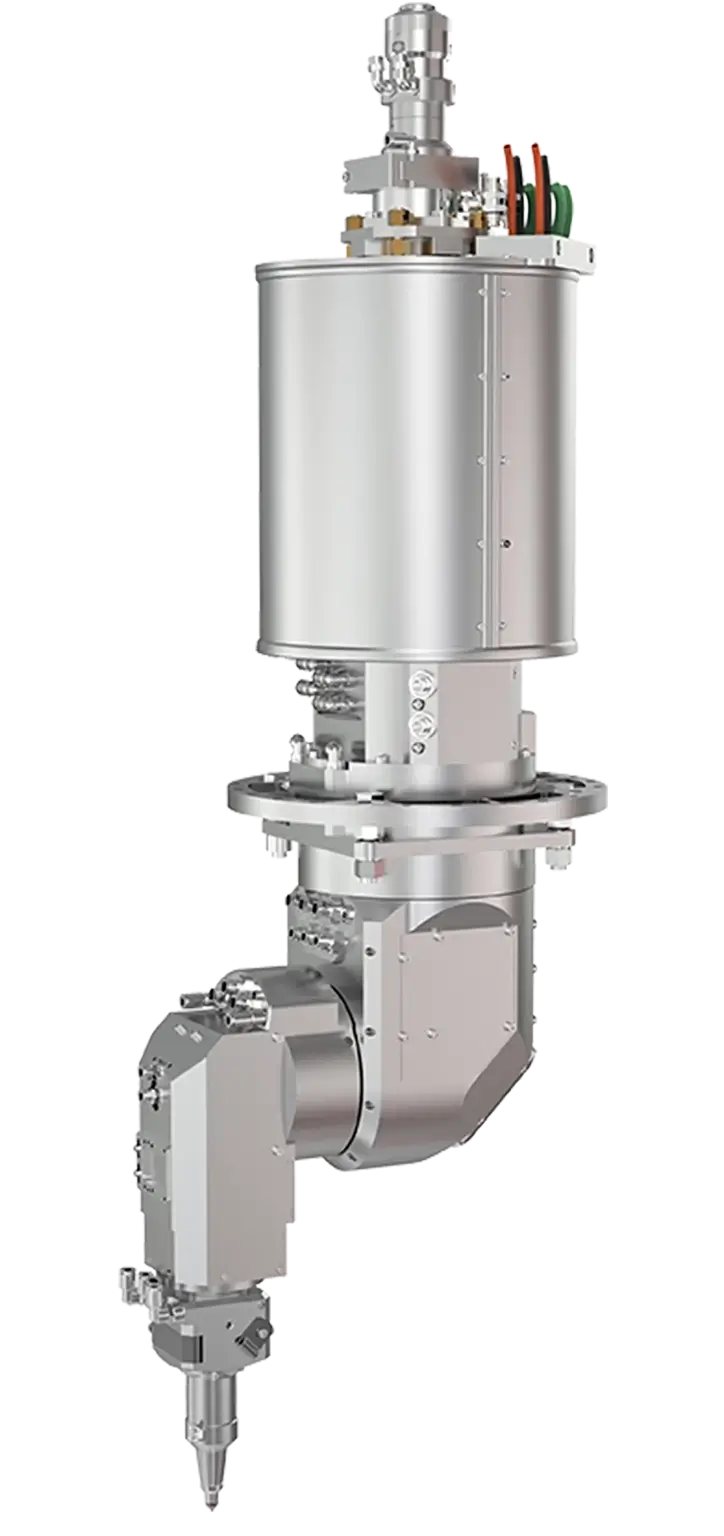
ProMark OEM 20W/30W Pulsed Fiber Laser
High-speed 1064nm galvo marking engine designed for inline conveyor and automated turntable integration.
- Wavelength: 1064 nm
- Pulse Duration: 100 ns
- Cooling: Air Cooled
- Interface: I/O, RS232, Ethernet
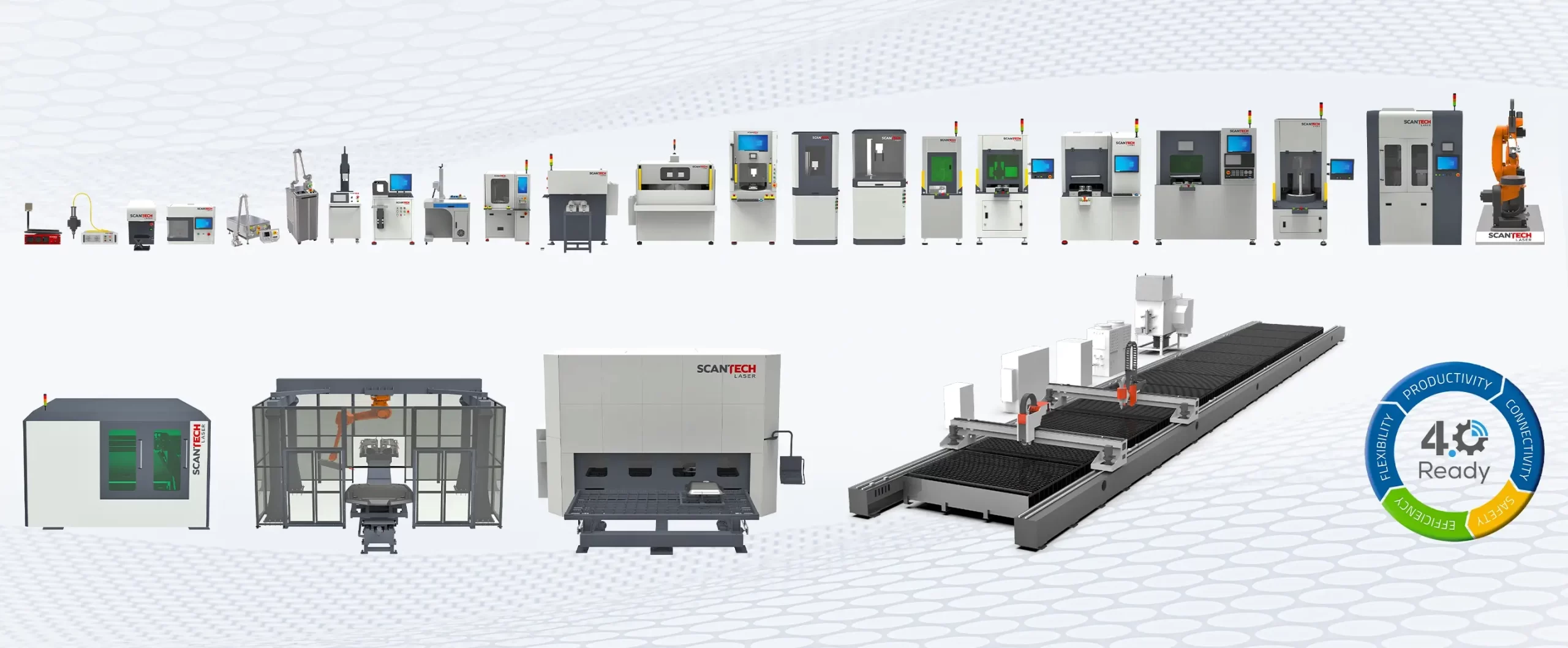
Configuring an industrial laser system requires precise matching of laser-material absorption, pulse duration, scan optics, and duty cycle. Use our engineering matrix below to identify the standard machine platform for your production volume.
High-speed 1064nm galvo marking engine designed for inline conveyor and automated turntable integration.
Adjustable pulse width (2ns to 500ns) for corrosion-free black marking on anodized aluminum and color marking on stainless steel.
Dynamic capacitive height tracking, closed-loop gas control, and automated CNC motion for hydroformed automotive profiles.
Designed for EV battery busbars, copper-to-aluminum joinery, and wear-resistant brake disc laser cladding layers.
Substrate-safe removal of oxide layers, paint coatings, grease, and corrosion prior to automated welding or bonding processes.
GMP-compliant non-contact tablet marking system featuring inline vision inspection, automated reject gate, and 21 CFR Part 11 readiness.
Since 1991, Scantech Laser's applications engineering team has analyzed thousands of material samples to match process physics with industrial ROI. Here is how our engineers evaluate system suitability for export customers.
| Laser Source Wavelength | Primary Material Classes | Material Interaction Regime | Recommended Machine Platform |
|---|---|---|---|
| 1064 nm Fiber Laser | Carbon steel, stainless steel, brass, copper, high-density polymers | Thermal annealing, ablation, keyhole melting | ProMark Fiber, Fiber Cutting, Wobble Welding |
| 355 nm Ultraviolet (UV) | White/colored polymers, glass, ceramic substrates, delicate foils | Photochemical cold ablation (minimal thermal stress) | ProMark UV Workstation, Wafer Scribing |
| 532 nm Green Laser | Highly reflective metals (Gold, Silver, Raw Copper), silicon wafers | High peak-power absorption at shorter optical wavelengths | Green Micro-Drilling & Scribing Station |
| Ultrafast (Pico/Femto) | Medical implants, nitinol tubes, thin-film PV cells, sapphire | Athermal non-linear multiphoton ablation (Zero HAZ) | Precision Micro-Machining Cell |
Every standard and custom laser system undergoes rigorous Factory Acceptance Testing (FAT) at our Navi Mumbai manufacturing plant before international dispatch.
Standardized mechanical assembly, optical axis alignment, and thermal burn-in testing prior to shipment.
Interlocked enclosures compliant with IEC 60825-1 and US FDA 21 CFR 1040.10 radiation safety standards.
Export buyers receive metallurgical cross-section reports, pull-test data, and speed metrics on their own parts.
Secure PLC and laser-controller remote access enabling immediate technical diagnostics and parameter optimization.
Send your component drawings, target cycle times, and material specifications directly to our senior application engineers.
Key considerations evaluated by procurement managers, machine integrators, and plant engineers during laser system selection.
Standard Pulsed Fiber Lasers (Q-switched) operate at fixed pulse durations (typically 100ns) and are highly cost-effective for deep metal engraving, steel annealed marking, and barcode etching. MOPA (Master Oscillator Power Amplifier) lasers allow adjustable pulse durations from 2ns to 500ns, providing precise thermal control needed for high-contrast black marking on anodized aluminum, heat-sensitive plastics, and colored laser marking on stainless steel without surface corrosion.
Yes. Scantech Laser designs both standalone Class 1 laser enclosures and OEM modular laser engines equipped with industrial communications protocols (Profinet, EtherNet/IP, Modbus TCP) for seamless integration into robot-fed, indexing turntable, or inline conveyor systems.
All Scantech laser systems are manufactured in ISO 9001:2015 certified facilities. Machine enclosures are designed to IEC 60825-1 and 21 CFR 1040.10 Class 1 safety standards, featuring safety-interlocked access doors, certified laser safety viewing windows, and integrated active fume extraction interfaces.
Standard laser marking and cleaning machines typically ship within 3 to 4 weeks following Factory Acceptance Testing (FAT). Special Purpose Machines (SPM) follow a structured engineering phase: CAD approval, FAT sign-off, export-compliant wooden crating, on-site or supervised SAT commissioning, and complete operator documentation.