OEM/ODM Laser Cutter Manufacturers & Exporters

Industrial-grade Fiber, UV & Ultrafast Laser Cutting, Welding, and Surface Processing Systems Engineered to ISO 9001 Standards for Global Manufacturing Supply Chains.

Direct Factory Catalog

High-Efficiency Laser Cutting, Welding & Cleaning Lineup

Explore our flagship portable, handheld, and multi-functional 4-in-1 fiber laser machines engineered for high productivity, minimal heat-affected zones (HAZ), and heavy-duty industrial continuous duty cycles.
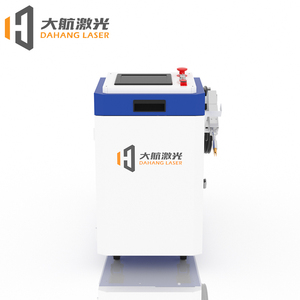
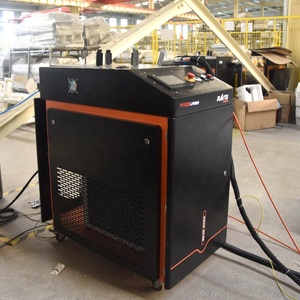
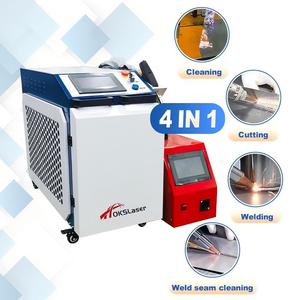
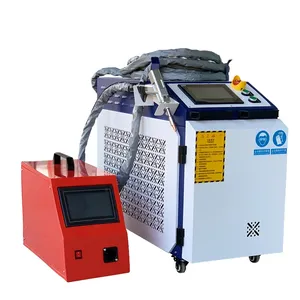
Multi-Function 4-in-1
Laser Welders 4 Functions 1500W 2000W 3000W Handheld Laser Cutting Cleaning Machine

Laser Welders 4 Functions 1500W-3000W Handheld Laser Cutter Cleaner

Power Range:1500W - 3000W
Functionality:Cut/Weld/Clean/Seam
Water Cooling
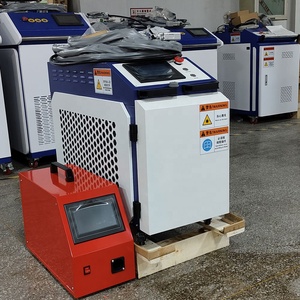
Water Cooling 4 In 1 Small Portable Laser Welding Cleaning Machine Metal

Compact Industrial Water-Cooled 4-in-1 Portable Fiber Laser Cutter

Cooling Tech:Dual-Chiller Water
Portability:Compact Mobile Rig
Precision Fiber
Portable 1000w 1500w 2kw Handheld Fiber Optic Laser Cutting Machine

High-Precision Portable 1000W/1500W/2000W Handheld Fiber Laser System

Fiber Source:Raycus/Max/IPG
Repeatability:±0.02 mm
Heavy Industry
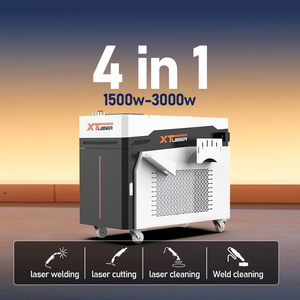
Laser Cutting Welding Machine Price for Metal 4 in 1 1500w 2000w 3000w

Industrial Metal Fabrication 4-in-1 Laser Cutter & Welder Workstation

Sheet Metal:Up to 8mm CS/SS
Wobble Head:0-5mm Dynamic
2026 Next-Gen
2026 4in1 Handheld Laser Machine 1500w 2000W 3000w Metal Cleaner Cutter

2026 Series 4-in-1 Handheld Laser Cutter, Cleaner & Seamless Welder

Efficiency:>38% Electro-Optic
Control UI:Touchscreen Smart PLC
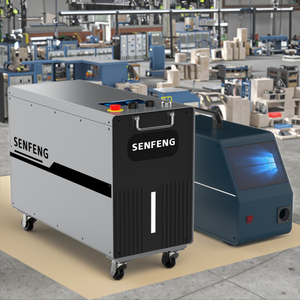
High Productivity
New 4-in-1 Laser Cleaner Welder Cutter Portable Hand-Held High Productivity

High-Productivity Handheld Fiber Laser Processing Rig (1500W-2000W)

Wire Feeder:Auto Twin-Drive
Safety Class:Class 4 / Enclosed
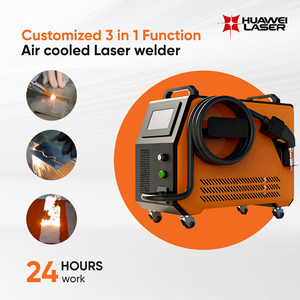
Air-Cooled Tech
Mini Laser Welding Machine 800W 1200W Air Cooling Handheld Fiber Laser Welder

Ultra-Portable Air-Cooled Mini Laser Cutter & Welder (800W-1200W)

Weight:<40 kg Portable
Cooling:Active Air Refrigeration
Global Stock / EU US
3000W 4 In1 Fiber Laser Welding Cleaning Cutting Soldering Machine Max BWT

3000W Industrial Fiber Laser Cutting, Cleaning & Soldering Machine

Laser Engine:Max / BWT 3000W
Certifications:CE / FDA / ISO
35+
Years In Laser R&D
10k+
Global Systems Operating
±0.01mm
5-Axis Motion Precision
24/7
Remote Diagnostic Network

The Architecture of Modern OEM/ODM Laser Cutting & Processing Machinery

The industrial thermal processing domain has experienced a seismic shift from conventional mechanical shearing, plasma cutting, and TIG welding toward solid-state fiber laser architectures. As global manufacturing demands tighter tolerances, zero recast layers, reduced kerf width, and absolute repeatability, original equipment buyers require full transparency into the photonics, kinetic motion systems, and beam parameter metrics governing modern laser cutters.

At Scantech Laser (engineering laser platforms since 1991), our manufacturing philosophy revolves around absolute optical efficiency and structural rigidity. Whether integrated into a standard sheet metal gantry or deployed as a dynamic 5-axis robotic cell, an industrial laser cutter is only as reliable as its weakest sub-assembly. Below, we break down the engineering fundamentals that define world-class OEM laser manufacturing.

Beam Quality (M² & BPP)

Maintaining an M² < 1.2 for single-mode fiber engines ensures minimal beam divergence, allowing focal spot diameters down to 20 microns for high-speed precision kerf cutting.

Kinematic Dynamics

Dual servo-driven rack-and-pinion or linear motor motion stages capable of 1.5G to 2.0G acceleration keep edge cycle times optimal without inducing structural frame chatter.

Closed-Loop Gas Control

Automated switching between high-pressure Nitrogen (for oxide-free stainless steel cuts) and Oxygen (for exothermic carbon steel slicing) maximizes consumable life.

Photonics Engineering: Selecting Wavelengths for Advanced Substrates

A critical challenge for OEM procurement officers is matching laser engine wavelengths to material absorption profiles. Standard continuous-wave (CW) fiber lasers operating at 1064 nm dominate ferrous metal processing due to their electrical-to-optical conversion efficiency exceeding 38%. However, non-ferrous reflective alloys (such as pure copper, brass, and precious metals) exhibit poor absorption at 1064 nm in cold states, often causing back-reflections that damage unisolated optical cavities.

To solve this, advanced OEM/ODM custom builds utilize specialized optical pathways:

  • Near-Infrared Fiber (1064 nm): Ideal for structural carbon steel, stainless steel, aluminum alloys, and high-speed multi-process handheld applications (weld/clean/cut).
  • Green Fiber Lasers (532 nm): Specifically engineered for high-conductivity copper foil cutting and battery tab welding, offering up to 80% initial absorption without thermal spatter.
  • Ultrafast Picosecond & Femtosecond Lasers (1030 nm / 515 nm): Sub-picosecond pulse durations allow cold ablation, removing material at the atomic layer without thermally altering heat-sensitive semiconductors, medical stents, or ceramic substrates.

Engineering Specification Matrix: Handheld & Gantry Fiber Cutting Systems

The following performance matrix reflects test data compiled from our Navi Mumbai Applications Engineering Laboratory across standard structural alloys:

Laser Power Core Fiber Dia. Carbon Steel Max Cut Stainless Steel Max Cut Assist Gas Pressure Max Processing Speed
1000W CW 50 µm 10.0 mm 4.0 mm (N2) 1.2 - 2.0 MPa 8.5 m/min (1.5mm SS)
1500W CW 50 µm / 100 µm 14.0 mm 6.0 mm (N2) 1.5 - 2.5 MPa 12.0 m/min (1.5mm SS)
2000W CW 50 µm / 100 µm 18.0 mm 8.0 mm (N2) 1.5 - 2.5 MPa 18.0 m/min (1.5mm SS)
3000W CW 100 µm 22.0 mm 10.0 mm (N2) 2.0 - 3.0 MPa 25.0 m/min (1.5mm SS)
6000W High Power 100 µm 28.0 mm 16.0 mm (N2) 2.0 - 3.0 MPa 40.0 m/min (1.5mm SS)

Future Procurement Trends in Industrial Laser Manufacturing (2026–2030)

Procurement directors and factory automation leads must look beyond basic acquisition costs and anticipate shifting global regulatory and technology trends. As supply chains regionalize and production lines adopt Industry 4.0 architecture, several defining trends are reshaping laser equipment specifications:

1. Convergence of Multi-Process Handheld Systems (4-in-1 Architecture)

The traditional shop floor required separate dedicated machines for cutting, TIG/MIG welding, seam cleaning, and surface passivation. The rapid evolution of high-speed wobble galvo heads has enabled lightweight, 4-in-1 handheld fiber systems. By altering focal length and optical wobble frequency (up to 300 Hz) via touchscreen presets, operators can switch from cutting 4mm sheet metal to performing hermetic welds or cleaning mill scale—slashing capital expenditure (CapEx) for small-to-medium fabricators by over 60%.

2. High-Speed Cladding & Euro 7 / BS7 Particulate Compliance

Environmental standards such as Euro 7 and Bharat Stage 7 mandate dramatic reductions in non-exhaust particulate emissions—specifically brake dust generated by automotive braking systems. High-Speed Laser Cladding (HSLC) has emerged as the essential manufacturing process to deposit metallurgical wear-resistant carbide coatings onto gray cast-iron brake discs. Delivering deposition rates above 20 m/min with dilution levels under 5%, HSLC extends component lifespans while meeting stringent global clean-air directives.

3. Automated 5-Axis 3D Processing for Hydroformed Components

Automotive lightweighting initiatives rely heavily on high-strength hydroformed tubular profiles and hot-stamped 3D steel components. Standard 2D flatbed cutters are incapable of processing these complex geometries. OEM procurement is rapidly pivoting toward dynamic 5-axis laser cutting heads equipped with non-contact capacitive height tracking and anti-collision breakaway sensors, enabling multi-angle beveling and profile cutting in a single setup.

Custom OEM/ODM Integration & White-Label Capabilities

Looking for a custom turnkey laser cutting chassis, specialized CNC software skin, or private-labeled housing tailored to your brand identity? Scantech Laser provides comprehensive ODM services—from optical ray tracing and mechanical finite element analysis (FEA) to CE/FDA compliant enclosure manufacturing.

Get Catalog

E-E-A-T Enterprise Strengths: Why Leading Exporters Choose Scantech Laser

Selecting an OEM/ODM manufacturing partner requires strict validation of the supplier's engineering depth, quality management systems, and post-commissioning infrastructure. With over three decades of optical innovation based in Navi Mumbai, India, Scantech Laser offers unmatched structural advantages:

  • In-House R&D and Metallurgical Testing Lab: Every standard and special-purpose machine is validated using cross-sectional metallography, pull testing, and laser beam profiling to verify process windows before batch production.
  • ISO-Compliant Precision Assembly: Our manufacturing facility adheres to strict ISO 9001 quality protocols. Machine bases undergo stress-relieving heat treatment and precision granite-bed hand scraping to eliminate micro-vibrations during high-g accelerations.
  • Class 1 Machine Safety Enclosures: Safety is non-negotiable. All export-grade machines feature fully enclosed Class 1 laser safety housings with optical density (OD 6+) certified viewing windows, dual-circuit safety interlocks, and integrated high-CFM fume extraction ports.
  • Global 24/7 Diagnostics & Supply Chain Resilience: Equipped with remote IoT telemetry modules, our engineers can diagnose laser source status, galvo drift, and PLC I/O signals anywhere in the world, minimizing unplanned downtime.
Procurement Guidance

Frequently Asked Questions (FAQ)

Technical answers to common sourcing, optics, and integration questions encountered by global buyers.

What key metrics determine whether a laser cutter requires air cooling versus water cooling?
Air-cooled laser sources are typically limited to lower average power outputs (up to 1200W handheld or pulsed marking applications) operating in climate-controlled environments. Higher power continuous-wave (CW) systems (1500W to 3000W+) generate substantial waste heat in both the fiber laser diode modules and the optical cutting head. These require dual-circuit water chillers to independently maintain the fiber source at ~25°C and the cutting optics at ~30°C, preventing thermal lensing and beam mode degradation.
How does an OEM custom laser build address heat-affected zone (HAZ) minimization in thin metals?
To minimize HAZ in thin or heat-sensitive metals, we optimize three parameters: using high-frequency pulse modulation (Q-switched or MOPA fiber engines), utilizing small core-diameter fibers (50 µm or smaller) to increase energy density ($W/cm^2$), and increasing cutting feed speeds while maintaining high assist gas pressure (Nitrogen at 2.0+ MPa) to rapidly eject molten material before conductive thermal transfer occurs.
Can Scantech Laser integrate custom PLC software and private-label skins for OEM distributors?
Yes. We regularly supply international OEM distributors with custom-branded machine enclosures, personalized CNC human-machine interfaces (HMI), and customized PLC software architectures. This includes pre-installed cut-recipe databases tailored to your target industry, multi-language support, and native integration with standard MES platforms (Profinet, EtherCAT, Modbus).
What export documentation and international safety standards accompany machine shipments?
All export machinery ships with comprehensive Factory Acceptance Testing (FAT) reports, laser safety compliance documentation (CE / FDA CDRH registration numbers), electrical schematics complying with EN 60204-1 standards, and complete operation and maintenance manuals. For pharmaceutical or medical customers, we provide IQ/OQ protocol execution support.

Ready to Accelerate Your Laser Manufacturing Capabilities?

Connect directly with our optical engineering team in Navi Mumbai. Request a comprehensive product catalog, schedule a sample part cutting trial, or discuss private-label OEM partnership opportunities.

Get Catalog