Engineered for extreme performance, low heat impact, and zero material degradation across global manufacturing environments.
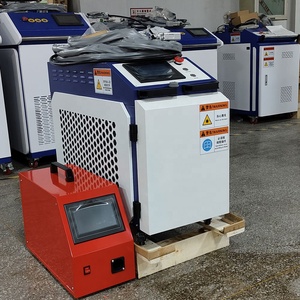
Versatile fiber laser system combining continuous-wave rust cleaning, seam welding, precise cutting, and weld-bead cleaning.
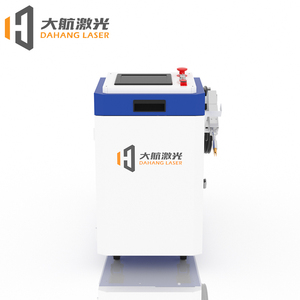
Ultra-compact form factor designed for field maintenance, small workshops, and intricate metal surface oxide stripping.
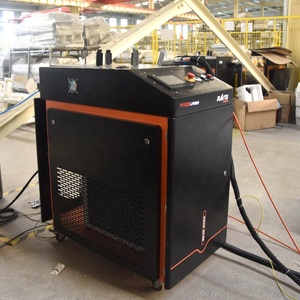
High-beam-quality laser delivering concentrated energy for deep rust scaling removal and clean keyhole welding.
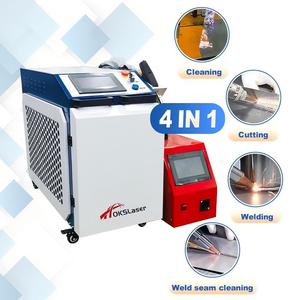
Heavy-duty chassis built for automotive and fabrication plants requiring rapid oxide layer vaporization and strong joints.
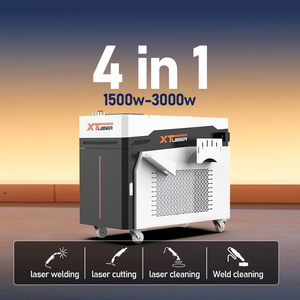
Next-generation control software with preset process parameter recipes for instant switching between cleaning and welding modes.
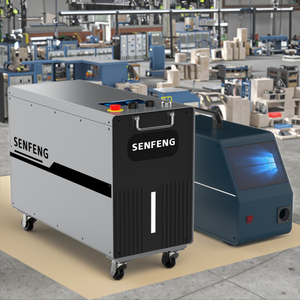
Optimized beam delivery system ensuring uniform energy density across large rust removal swaths without overheating metals.
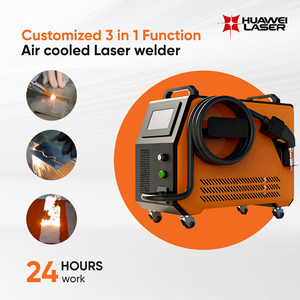
Chiller-free air-cooling technology providing unmatched field portability, sub-zero operation tolerance, and minimal maintenance.
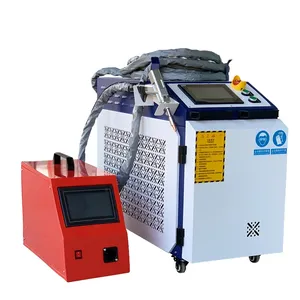
Maximum-power continuous wave fiber system configured with dual wire-feeders for heavy structural rust removal and thick plate welding.
Industrial laser cleaning operates at the intersection of quantum optics, thermodynamics, and surface chemistry. Understanding the light-material interaction is essential for selecting procurement specifications that balance throughput with substrate preservation.
Laser rust removal relies on the differential absorption coefficient of iron oxides ($\text{Fe}_2\text{O}_3, \text{Fe}_3\text{O}_4$) relative to the underlying metal substrate. When a high-peak-power fiber laser beam (1064 nm wavelength) strikes a oxidized metal surface:
Choosing between Continuous Wave (CW) and High-Peak Pulsed laser cleaning systems defines the operational window for industrial procurement:
Engineering Rule of Thumb: For heavy fabrication and structural rust removal where speed and cost-per-watt are primary metrics, 2000W–3000W CW 4-in-1 laser systems provide 5x to 8x higher ROI than traditional chemical pickling or sandblasting.
| Technology | Processing Speed | Substrate Wear | Consumables / Waste | Environmental / ESG | OpEx / Hour |
|---|---|---|---|---|---|
| Fiber Laser Cleaning | Very High (up to 45 m²/h) | Zero to Negligible (<0.001mm) | Electricity Only (No Media) | Zero Emission / Eco-Friendly | Low ($0.80 - $1.50) |
| Grit / Sand Blasting | Medium (10-15 m²/h) | High Surface Abrasion | Grit Media, Dust Filters | High Airborne Dust Hazard | High ($6.00 - $12.00) |
| Chemical Acid Pickling | Slow (Batch Dip Dependent) | Chemical Etching Risk | Toxic Acid, Neutralizers | Severe Hazardous Waste Disposal | High ($8.00 - $15.00) |
| Dry Ice Blasting | Medium (8-12 m²/h) | Zero Substrate Wear | Pelletized CO2 Blocks | CO2 Vapor Gas Release | Very High ($15.00 - $25.00) |
As global manufacturing shifts toward automation, sustainability, and hybrid operational capabilities, laser equipment procurement criteria are undergoing structural shifts.
Traditionally, high-power fiber lasers required bulky external water chillers. Modern optical fiber design now enables high-thermal-threshold sources. Air-cooled hand-held systems (such as 800W–1200W models) remove the need for deionized water, pumps, and refrigerant cycles, reducing machine weight by over 60% and enabling true field transportability in sub-zero or high-humidity environments.
Procurement managers no longer favor single-purpose machinery for maintenance and job-shop operations. The market is standardizing on 4-in-1 hybrid platforms that feature quick-change nozzle tips. Operators can transition from rust stripping to joint welding or sheet metal trimming in under 30 seconds via unified control interfaces.
Integrating galvo-wobble motion with machine vision cameras allows real-time surface rust mapping. The laser controller dynamically adjusts spot size, beam frequency, and laser power output depending on oxide thickness variations, preventing localized thermal distortion and cutting power consumption by up to 25%.
With over three decades of optical engineering heritage, our production infrastructure delivers reliable, industrial-grade equipment designed for rigorous continuous duty.
Every laser machine built in our facilities undergoes strict optical alignment in ISO Class 7 cleanrooms. Our engineering capabilities encompass:
We support global business partners with full regulatory compliance and turnkey post-sale logistics:
Direct technical responses to common questions raised by industrial buyers, quality managers, and manufacturing engineers.
No. Fiber laser rust removal relies on selective light absorption. Iron oxides absorb 1064 nm laser energy far more effectively than bare metal. Once the rust layer is vaporized, the high reflectivity of the clean substrate bounces back most of the laser energy. Operating within recommended scan parameters results in less than 0.001 mm substrate surface removal, maintaining original dimensional tolerances.
Selection depends primarily on required cleaning speed and scale thickness. A 1500W system is suitable for light to medium oxide, paint removal, and light welding seam prep (cleaning speed ~15–20 m²/hr). A 2000W system offers optimal performance for general industrial maintenance (~25–35 m²/hr). The 3000W system is engineered for heavy structural rust, thick mill scale, and continuous multi-shift production lines needing maximum throughput (~40–45 m²/hr).
Because 1064 nm fiber lasers are classified as Class 4 laser products, operators must wear certified laser safety goggles (OD6+ rating for 1060–1080 nm). Furthermore, workstations require proper fume extraction units with HEPA and activated carbon filtration to capture vaporized metallic particulates, keeping air quality safe and compliant with OSHA/CE standards.
The solid-state fiber laser source (Raycus / MAX / IPG) has an MTBF (Mean Time Between Failures) rating exceeding 100,000 operational hours (equivalent to over 10 years of standard use). The primary consumable is the protective quartz window lens inside the handpiece, which typically lasts 200 to 500 working hours depending on fume extraction quality and operator technique, and can be replaced in minutes.
Standard stock units ship within 7 to 10 business days from factory acceptance testing (FAT). Custom automated systems require 25 to 35 days. Overseas deliveries include complete operating manuals, video tutorials, electrical wiring diagrams, and remote video commissioning support with our technical applications desk.
Contact our application engineering team today for a free sample testing report, custom ROI calculation, or live video demonstration.