0%

Choosing a Brake Disc Laser Cladding System in 2026 means balancing coating quality, production speed, and reliable process control. The decision is becoming more important as manufacturers face tighter expectations for brake emissions and component durability. Regulation (EU) 2024/1257, commonly known as Euro 7, introduces limits for brake particle emissions, including 3 mg/km for electric cars and 7 mg/km for most other cars. These figures make surface engineering a practical consideration, not just a laboratory topic.

The numbers need context. A cladding system cannot guarantee lower emissions by itself; results depend on the disc material, coating design, machining, and validation tests. Still, a stable laser process can apply a wear-resistant layer while limiting heat input compared with some conventional deposition methods. That matters when a thin coating must remain consistent across a rotating disc, including near edges and mounting features. Small defects count.

This guide explains how to compare laser power, beam delivery, powder feeding, automation, and inspection options. It also looks at operating costs, service support, and the evidence suppliers should provide. The European Commission’s Euro 7 regulation offers a useful regulatory reference, while published materials and tribology studies help buyers assess coating performance. Ask for test conditions, not just headline results. A demonstration using your disc geometry and target production rate is more informative than a brochure. One caveat: promising laboratory data may not predict long-term performance on every vehicle platform.
2026 How to Choose a Brake Disc Laser Cladding System?

What Is a Brake Disc Laser Cladding System?

A brake disc laser cladding system repairs or upgrades disc surfaces using a controlled laser heat source. It feeds metal powder or wire into the melt pool. The laser creates a metallurgical bond, unlike a simple painted or sprayed layer. This bond can improve wear resistance, corrosion protection, and service life. Heat remains localized. That matters because excessive heat may distort the disc.

A complete system usually includes a laser head, material feeder, shielding gas supply, motion platform, sensors, and control software. During operation, the laser scans the braking surface while adding a precise coating. The process can cover worn areas or produce a new engineered layer. Surface flatness is critical. Even a small thickness variation may cause vibration, noise, or uneven braking. Final machining and inspection are often necessary.

Choosing a system requires more than checking laser power. The equipment must match disc diameter, coating material, production speed, and required thickness. Test coupons can reveal bonding quality before full-scale production begins. Measure hardness, porosity, roughness, and dimensional change. A practical warning: higher power does not automatically mean better results. My initial assumption was that faster deposition would reduce costs, but unstable powder flow created rework. Process records, operator training, and repeatable calibration are equally important. Some applications still need further testing because laboratory results may not reflect road conditions.

How Does Brake Disc Laser Cladding Work?

How Does Brake Disc Laser Cladding Work?

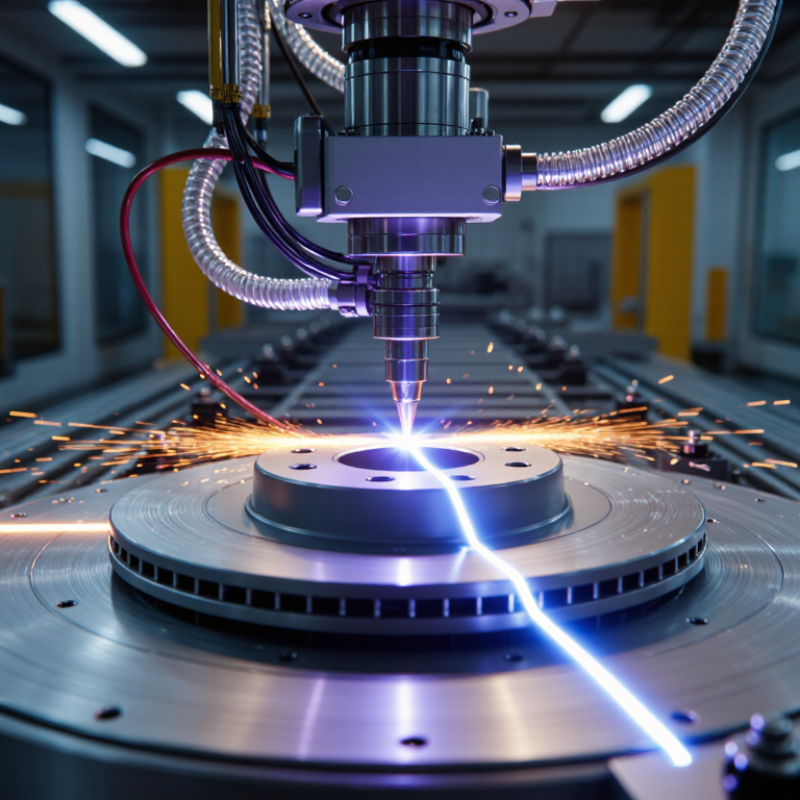
Brake disc laser cladding restores a worn surface by bonding a thin layer of metal alloy to the disc. A laser creates a small molten pool while powder is fed into the focused beam. The powder melts and fuses with the base material, forming a dense coating with limited dilution. The exact result depends on the alloy, laser power, powder feed rate, and travel speed.

The process moves across the disc in overlapping tracks. Imagine a bright, narrow beam tracing the swept area, with a controlled stream of powder entering the melt pool.

Operators monitor temperature and track spacing because uneven heat can cause distortion, cracks, or poor bonding. Small details matter.

The disc is typically cleaned and inspected before cladding, then checked for coating thickness, surface defects, and runout afterward.

Cladding is not a simple spray-on repair. It creates a metallurgical bond, but it does not automatically make every disc suitable for reuse. Material compatibility and heat management need careful evaluation. Even a well-coated surface may require machining to restore a smooth, parallel braking face. Real results vary, and that uncertainty deserves attention.

Which Technical Specifications Should You Compare?

2026 How to Choose a Brake Disc Laser Cladding System?

Which Technical Specifications Should You Compare?

Compare the laser’s power, spot size, and control range against the disc material and target coating. More power is not automatically better: excessive heat can distort a thin rotor or create a brittle heat-affected zone. Ask for measured cladding thickness, dilution rate, and hardness across a full test disc, not a small sample. Check whether the system records these values for each production run. Small details matter.

Feedstock compatibility is another key specification. Request the powder’s particle-size distribution, delivery rate, and batch traceability. Then inspect coating porosity, bond strength, and surface roughness using agreed test methods. ISO 21920 provides a framework for assessing surface texture, while SAE J2522 describes a dynamometer procedure for comparing brake performance. These standards do not certify a cladding machine; they help make supplier trials more comparable. That distinction is easy to miss.

Evaluate thermal management and cycle time under realistic conditions, including repeated runs and cooling periods. The European Environment Agency’s 2023 report on transport emissions identifies tyre, brake, and road wear as important sources of particulate matter, reinforcing the value of checking coating durability and wear performance. Ask suppliers for test data showing braking consistency, coating loss, and disc temperature over repeated stops. A polished demo disc proves little. Independent testing can be slower and costly, but skipping it may leave gaps in the specification.

How Do You Evaluate Materials, Quality, and Safety?

When choosing a brake disc laser cladding system, judge material compatibility before headline power. Ask suppliers to process your actual disc alloy and proposed powder, then inspect cross-sections for pores, cracks, dilution, and bond consistency. Record coating thickness and hardness at several points, not just one polished spot. ISO 6507-1 provides the Vickers hardness test method; it does not set a universal brake-disc hardness target. Set acceptance limits with your engineering team. Small detail, large consequences.

Quality needs repeatable evidence. Run trial discs through the same machining and dynamometer procedures, including friction, wear, and fade-and-recovery checks. SAE J2522 describes an inertia-dynamometer test procedure for brake friction materials; use its measured results as part of qualification, not as a substitute for validating your coated rotor. Compare batch-to-batch variation and inspect after testing. A neat first sample proves little. For safety, verify fume extraction, laser enclosure interlocks, guarding, and documented maintenance. ISO 12100 offers a framework for machinery risk assessment. One awkward point: operators may bypass controls under production pressure, so observe real shift routines, not only the written procedure.

2026 How to Choose a Brake Disc Laser Cladding System? - How Do You Evaluate Materials, Quality, and Safety?

Evaluation Area What to Check Practical Evaluation Criteria Evidence to Request
Brake-disc material Compatibility between the disc substrate and cladding alloy Confirm the system and procedure are validated for the actual disc grade, geometry, and surface condition. Do not assume one alloy or parameter set suits every cast iron or steel disc. Substrate identification, approved powder specification, and test results using representative production parts.
Cladding material Powder composition, particle-size distribution, and supply consistency Review the alloy chemistry against wear, corrosion, thermal, and machining requirements. Set powder acceptance limits with the material supplier and process engineer. Material certificate, lot traceability, particle-size report, and powder storage and handling instructions.
Laser source and control Power stability, beam delivery, and controllability of the process window Verify that the source can maintain the qualified power, spot size, travel speed, and overlap settings across the full swept surface. Confirm parameter logging and repeatability. Source specifications, calibration records, process recipes, and logged data from repeated production-representative runs.
Disc handling and motion Fixturing, rotation, runout control, and access to the braking surface Check that the fixture accommodates the intended disc range and maintains stable, repeatable positioning during cladding. Confirm loading, unloading, and changeover are practical. Fixture drawings, allowable part range, runout measurements, and a witnessed changeover trial.
Coating integrity Bonding, cracks, pores, inclusions, and dilution Define acceptance limits before production. Evaluate cross-sections and use suitable inspection methods to check for defects and verify bonding to the substrate. Metallographic sections, inspection procedure, defect records, and agreed acceptance criteria.
Thickness and surface finish Coating uniformity, final thickness, flatness, and post-process machining allowance Set thickness and dimensional requirements from the part drawing and brake-performance needs. Confirm the system can deliver sufficient machining allowance without compromising the finished surface. Thickness maps, dimensional inspection reports, and results after the planned finishing operation.
Performance validation Wear, corrosion, thermal behavior, and braking performance Use application-specific test plans and representative discs. Establish acceptance limits with the vehicle or component requirements; do not rely on hardness alone as proof of brake performance. Test protocols and reports for relevant wear, corrosion, thermal cycling, and braking evaluations.
Laser safety Enclosure, interlocks, access control, and laser hazard assessment Assess the complete machine and intended workplace. Verify guarding and safety functions against applicable requirements, including ISO 11553-1, IEC 60825-1, and ISO 12100 where applicable. Risk assessment, safety validation records, interlock test results, and operating and maintenance instructions.
Fume and powder control Local extraction, filtration, and control of powder exposure Provide extraction suited to the process and materials, with maintenance access and safe filter handling. Assess powder hazards and workplace exposure under local regulations. Extraction design, filter specifications, maintenance schedule, and relevant workplace exposure assessment.
Production readiness Cycle time, availability, traceability, and operator support Measure the complete cycle, including loading, cladding, cooling, inspection, and finishing. Confirm spare-parts support, training, maintenance access, and recipe control. Run-off results, documented maintenance plan, training materials, and sample production traceability records.

Note: Acceptance limits and process settings should be established for the specific disc design, material, production volume, and applicable regulatory requirements.

How Can You Select the Right System for Your Production Needs?

2026 How to Choose a Brake Disc Laser Cladding System?

Selecting a system starts with production facts, not advertised laser power. The IEA’s Global EV Outlook 2024 reports that electric cars reached about 18% of global new-car sales in 2023. Heavier vehicles and quieter operation can increase demands on disc durability and coating consistency. Define your disc diameter, material, hourly output, coating thickness, and acceptable cycle time before comparing equipment.

Do not select by laser wattage alone. A suitable system should control powder delivery, beam size, substrate temperature, and cooling. Coaxial cameras and pyrometers help monitor unstable melt pools. Measure dilution, hardness, adhesion, porosity, and disc runout after machining. Grand View Research’s 2024 laser cladding analysis identifies automotive applications as a major growth area, with market expansion projected at a double-digit rate. That growth does not guarantee every system fits your line.

Run trials with real discs, real powders, and your intended machining allowance. Record powder utilization, fixture changeover time, energy use, and rejection rates. A fast deposition rate may hide excessive finishing work. It happens. Check whether the supplier can provide process windows, calibration records, operator training, and traceable inspection data. ISO 14923 offers useful guidance for thermal spray process qualification, although laser cladding may require additional customer-specific validation. A production-ready choice should survive repeated shifts, not only produce one attractive sample.

FAQS

What is brake disc laser cladding?

It restores a worn surface by bonding a thin metal-alloy layer to the disc. This is not simply spraying.

How does the coating form?

A focused laser melts a small area while metal powder enters the beam. The molten powder fuses with the disc as the beam moves.

What does the finished coating look like?

It forms through overlapping tracks across the braking surface. The coating should be dense and evenly bonded, though results can vary.

What can affect cladding quality?

Alloy choice, laser power, powder feed, and travel speed all matter. Uneven heat can cause cracks, distortion, or weak bonding.

How is a disc checked before and after cladding?

The disc is cleaned and inspected first. Afterward, technicians check coating thickness, surface defects, and runout.

Does a coated disc always need machining?

No, but machining may be needed to restore a smooth, parallel braking face. A neat surface alone proves little.

How should material compatibility be evaluated?

Test the actual disc alloy with the proposed powder. Inspect cross-sections for pores, cracks, dilution, and consistent bonding.

What testing helps assess performance?

Measure coating thickness and hardness at several points. Also test friction, wear, and fade-and-recovery behavior on trial discs.

What safety details should operators check?

Verify fume extraction, laser enclosures, interlocks, guarding, and maintenance records. Watch real shift routines, too. Written rules can be overlooked.

Conclusion

Choosing the right Brake Disc Laser Cladding System requires a clear understanding of its purpose, operating process, and production requirements. This system uses a focused laser beam to melt and bond wear-resistant material onto the brake disc surface, creating a durable protective layer that can improve service life, thermal stability, and surface performance. During evaluation, manufacturers should compare laser power, cladding speed, coating thickness control, automation level, cooling design, and compatibility with different disc sizes and materials.

Material selection, quality assurance, and operational safety are equally important. The cladding material should match the required friction, heat, corrosion, and wear resistance, while the system should provide consistent coating quality and reliable process monitoring. Buyers should also assess equipment maintenance, operator training, protective enclosures, and compliance with applicable workplace standards. By balancing technical specifications, production volume, product requirements, installation conditions, and long-term operating costs, users can select a system that delivers stable performance and supports efficient, high-quality brake disc manufacturing.

Alexander

Alexander

Alexander is a highly experienced marketing professional dedicated to helping businesses understand complex products and make confident, informed decisions. With a strong background in market research, content strategy, customer communication, and digital marketing, he brings both commercial......